Showing posts with label drawing. Show all posts

Monday, December 12, 2011

Animation from America to Japan

Today's post will be a bit more of an intellectual one.  I have put together a term paper for one of my classes focusing on an aspect of animation I have been interested in learning more about, and will present it here as a post.  I hope you find it interested, and please feel free to contact me with questions or feedback.


Animation from America to Japan and Back
by David Hixon, © 2011

As early as 1915, Japan has been creating their own animations for public display.  However, despite these early films, animation in Japan didn't really come into its own until after WWII.  Anime as it is viewed today around the world really began with artists such as Osamu Tezuka, who created a series of manga which eventually became animated in a unique style.  However, if it wasn't for the animation from other countries and artists, in particular Walt Disney, he may never had inspired the anime genre as we know it.

I will explore the international influences that shaped anime into what it is today, and how that unique animation style has begun to affect mainstream media throughout the world.  Many people believe that the essence of anime has changed due to western influences, but I argue that western influences have always been strong in Japanese animation, and it is this clash of cultures that creates what is exciting and different.  I will begin by exploring how Western artists have influenced Japanese animators, focusing specifically on the works of Tezuka Osamu.  I will then explore the ongoing influences that go between eastern and Western artists, and how the cultures of these artists have begun to globalize.  I will finish by showing how the Japanese style of animation has invaded what we watch in theaters and on television today around the world.

The roots of anime really begin with early animators from America and Europe, such as Blackton and McCay.  In fact, by 1915, there were 21 foreign animations played nationally in Japan.  Both American and German artists, such as John R. Bray, the Fleischer brothers, and Lotte ReinigerIt, were strong inspirations for early Japanese animators.  A slew of animators emerged in Japan, including Shimokawa Oten, Kouchi Junichi, and Kitayama Seitaro, the earliest Japanese animators.  While they pioneered the techniques and genre, there was little they produced which was particularly worthwhile.  Shimokawa Oten was  trained as a caricaturist and cartoonist before being hired by Tenkatsu Studio to animate specifically in the style of Émile Cohl, while Kitayama Seitaro was particularly experienced with the Western style of painting.  Already, in the earliest years of anime, the Japanese style of animation was heavily influenced by the works of Western artists, not merely the techniques they pioneered.  These Western style influences were not limited to the origin of anime and continued into the 1930's.  Artists such as Ikuo Oishi broke away from other contemporary Japanese animators' styles, and modeled his characters after American animations such as Felix the Cat.  Yokoyama Ryuichi founded the Otogi Studio in Japan after having fallen in love with animation through Walt Disney's Skeleton Dance, which aired in Japan in 1930. He created several animations and manga, and would appear in the Mainichi newspaper.  He had the privilege to visit the Disney Studios in 1955, and met Walt Disney himself.

In the 1930's and 40's, the many Japanese animations were made as propaganda films during World War II, which probably caused a strain on the animators in terms of inspiration.  It seems likely that could they directly copy the styles of Western animators now that they were at war. And yet even during this troubling time, the animators would sometimes portray American soldiers as recognizable characters such as Bluto from Fleischer's Popeye as seen in Mitsuyo Seo's Momotaro, Eagle of the Sea released in 1943.  Political references like this continued throughout the war and beyond.  Even after the war, the government of Japan encouraged animators to make films that showed the possibilities of the West, such as the 1946 film by Masao Kumagawa, The Magic Pen.  However, this had little to do with the style of the animation, and more to do with propaganda.


It wasn't until a medical student decided in the 1950's to try his hand at manga and eventually anime that the modern style of anime was born.  Tezuka Osamu was privileged in his youth to have access to both manga and film, including animation.  Tezuka is said to have watched films like Felix the Cat in his youth, and was also influenced by Disney films, and French New Wave Cinema.  This lead to his unique way of looking at animation and manga as a cinematic experience in terms of film editing, camera work, and other cinematic devices.  His love of art and film from around the world gave him a unique viewpoint into the world of animation.  Even the character design of Astro Boy was an homage to the early Walt Disney character styles.

On the first day of 1963, Astro Boy (Tetsuwan Atomu) was aired in Japan, and in America soon after, which was during a time when there were limited channels and airtime on television.  One of the more interesting facts about this relationship between America and Japan was that Astro Boy would regularly mirror the civil rights struggles in America of the day, adding to the relations between the two countries and furthering the expansion of anime into the American market.  While Astro Boy started off roughly, it soon became a world famous show, spreading the art of Japanese animation early, and invading the homes of people around the world.  Tezuka produced several more series both before and after Astro Boy, which made big waves in America and abroad.  Of these, Kimba the White Lion (Jungle Emperor) was among the most popular on American television. 
In1967, Yoshida Tatsuo's Speed Racer (Mach Go Go Go) was aired in America as well.  It gained popularity on American television, and eventually the original manga it was based on was released to western audiences as well.  It became an icon of Japanese animation in its own right.

We can clearly see here that the Japanese styles used in animation were heavily influenced by their American and Western colleagues since the earliest days of Japanese produced animations.  These influences continued throughout the decades, culminating in the cinematic styles that Tezuka adopted.  While it is clear that the origins of anime were influenced as such, the American audience was also being slowly introduced to the phenomenon known as Anime, and despite the often controversial and bizarre shows, it became engrained in the minds of future American film makers and animators.

Astro Boy has been translated into over a dozen different languages, and Tezuka himself was one of the first Japanese artists to attend international festivals for comics and animations.  He not only pioneered airing his shows in America, but around the world, and was critically recognized for his work.  The influential styles of Japanese animation were not limited to Japan, and had already been seen by artists and future animators around the world.  One film which shows this obvious cross-pollination of story telling and visuals is Disney's 1994 hit movie The Lion King.  Many critics have pointed out the many similarities between this film and Tezuka's Kimba the White Lion.  Kimba aired on American television stations in the 60's and 70's, and many of the animators who worked on The Lion King would have grown up watching Kimba on television.  Critics have claimed Disney heavily “borrowed” from Tezuka, and controversy over the idea of homage versus plagiarism sparked.

While the films and animations of Japan continue to spread throughout the world, both the styles and culture of Japan spread with it.  Historically, Japan has been heavily influenced by Western cultures, and yet continues to hold onto their own unique perspective and cultural identity.  It is this mix of West meets East, tradition meeds modernization, that has shaped the very soul of modern day Japan.  Japan is becoming a country of a globalized culture, where they struggle to find their own identity and a place to fit within the world.  Anime is one way in which Japan has turned the tables, and allowed their art to influence other cultures more than their own, and yet it also conforms to many globalized standards.

Characters in anime productions are often depicted with large eyes, multiple colors of hair and eyes, and even skin.  While the characters are not always intended to be from another country, they are more often than not Western looking, copying the styles and appearance of Western cultures and people.  Characters often have blond, brown, or even red hair, as well as a slew of eye colors, which directly mimic these foreign people.  On the other hand, many anime characters also sport blue, green, purple, or even pink hair, as well as red or purple eyes, and even blue or green skin.  This seems bizarre, but is one of the defining characteristics of anime, and brings it out of any particular culture and into something all it's own.  By adopting a non-Japanese, or even “stateless” look in the characters is part of what makes anime so easily acceptable by cultures around the world.

Such mixing of ideas and styles goes both ways.  Several television shows and movies in America directly reflect the Japanese style, and even the anime characteristics that define it.  Avatar: The Last Airbender is one such show.  The directors and producers not only copied themes, styles, and designs as well as cultural references for their series from Japanese animation, but they also researched what studios to use, and chose a Korean studio that had previously worked on Japanese anime and were familiar with the style and demands of the process.  And it is not alone.  Several studios are adopting an anime style for certain shows, in order to reach the demographics they are looking for.  They are not just trying to mimic the look either, they are looking to emulate the style to a point where it is impossible to tell the difference between “Anime” produced in Japan versus America, at least in terms of quality and story-telling.  At the very least, studios are trying to take visual and stylistic cues, and leave the real anime style to the Japanese masters.

Many American and Japanese comics are already cross-pollinating, and both manga and anime are becoming less and less a product strictly of Japan, even if the primary demographic is Japanese.  The majority of Japanese anime with Western money backing it seems to be from making sequels and projects that did poorly in the Japanese market.  The West's desire to acquire or produce Eastern, and particularly Japanese art dates back to the 19th Century.  Anime shows a mix of traditional Japanese art that was so fascinating to the people of the time, such as Kabuki and Woodblock Prints (Ukiyo-e), and modern and even experimental cinema and artistic tools.

While many American studios have shied away attempting to emulate the Japanese style, and others have tried to make it their own, there have been several projects developed that are joint-projects between Japanese and American groups.  Warner Brothers Studios  commissioned a series of short animations from various anime studios and producers in Japan on more than one occasion, each time with a different movie they are to be based on.  Animatrix, released to home video in 2003, is a collection of short animations, each with a different Japanese director, focusing on telling more of the story of the Wachowski Brother's Matrix.  Again in 2008, they released Batman Gotham Knight under the same pretense.

These collaborations have extended into full length films as well.  Several remakes and re-imaginings of different anime and manga stories have been produced in America, and several more are in production and planning.  In 2009, a mainly American produced version of Astro Boy was released to theaters, with some limited interaction and approval by Tezuka Productions.  This followed the 2008 release of Speed Racer, and several other anime-to-live-action remakes.  This trend, to turn anime into live-action films, tends to produce mixed results, and yet there are several more films in the works for the next few years.

Beyond remaking anime series and movies for a Western audience, either through live action or animation, the most notable influence of anime in western cinema is the style it inspires in original Western works.  Blockbuster films, such as 300, The Matrix, Kill Bill, and even Up, and Ratatouille, are directly inspired by the cinematic and visual styling of anime.  Kill Bill went so far as to include an animated sequence produced by a Japanese animation studio in the middle of the film.  However, the most interesting influences are those between anime and animation.


Hayao Miyazaki fell in love with animation in 1958, when he was in high school, and went on to create one of the most influential animation studios in the world.  His first major motion film, which was Castle Cagliostro, made way for his much more epic masterpieces, such as Nausicaä of the Valley of Wind, that defined his style and the studio he started, Studio Ghibli.  He was not a fan of Disney-style animation, in both the use of cinematography, and rotoscoping.  He wanted to create a truly Japanese style of animation which focused more on the essence of animation in expression and motion, rather than smoothness of motion.  However, he was still heavily influenced by western cartoonists such as McCay, Fleischer, Back, and Norstein.  Because of his unique way of looking at animation, from writing the telling the story to the art style and visuals, his animations have influenced artists world wide.

Many artists, including those at Pixar Studios, grew up watching Miyazaki's films as a children, and continue to draw inspiration from him in their movies.  Many have studied the drawings and animations Miyazaki made, and used what they could learn from him to his work in films like Up, and Ratatouille.  Miyazaki himself became friends with John Lasseter of Pixar, visiting him at Pixar Studios on what Lasseter announced was “Miyazaki Day at Pixar”.

This type of international relationship between East and West are becoming more commonplace, and as a result, the highly stylized art and often adult and mature themes of anime have begun to spread globally and permeate cultures around the world.  As a result, it can be said that Japan is losing its singular unique identity, but replacing it with a unique cultural identity of contrasting elements of society and art.  Japan is both traditional and modern, conservative and edgy, and this contrast is reflected in the animation they have produced.  As a result, it is easily accepted in many cultures around the world, and has influenced the artists, cartoonists, sequential artists, and filmmakers of tomorrow, and today.  While the rest of the world struggles to keep up with the style of anime, the Japanese artists have drawn on inspirations from other cultures to make their art more unique and universal.

The future for anime is bright, and with international collaborations, it will prove to be even brighter.  Anime was born from the unique perspective of Eastern artists studying Western art, while drawing upon their own past and experiences to support it.  Thanks to efforts from artists such as Tezuka and Miyazaki, anime will continue to be an international influence on film, pushing the envelope and advancing what is possible on film, by unleashing the imagination.


Bibliography

Cavallaro, Dani. (2006). The Anime Art of Hayao Miyazaki.  Jefferson, N.C.: McFarland & Co.
Drazen, Patrick. (2003).  Anime Explosion!  The What? Why? & Wow! Of Japanese Animation.  Retrieved from
Kime, Chad. (n.d.).  American Anime: Blend or Bastardization?.  Accessed on October 9th, 2011.  Retrieved from
Koyama-Richard, Brigitte. (2010). Japanese Animation: From Painted Scrolls to Pokémon. Paris, France: Flammarion.
Lamarre, Thomas. (2009). The Anime Machine. Minnesota, MN: University of Minnesota Press.
Lu, Amy Shirong. (2008).  “The many faces of Internationalization in Japanese Anime”.  Animation: An Interdisciplinary Journal.  Retrieved from
Miyazaki, Hayao.  (January 28th, 1988).  “About Japanese Animation”. Course Japanese Movies 7: The Current Situation of Japanese Movies. Iwanami Shoten.  Translated by Ryoko Toyama.  Accessed on November 5th, 2011.  Retrieved from
Napier, Susan J. (2005) Anime from Akira to Howl’s Moving Castle.  New York, NY: Palgrave Macmillan.
Sharp, Jasper.  (2004).  Pioneers of Japanese Animation at PIFan.  Accessed on November 5th, 2011.  Retrieved from
Van der Lugt, Peter.  (n.d.).  Exclusive Interview with Pixar Storyboard Artist Enrico Casarosa.  Accessed on October 9th, 2011.  Retrieved from
Zahed, Ramin. (November 2004). “Astro Boy's American Cousins”.  Animation Magazine, vol 18 (no. 11). 

Filmography
  Bender, Lawrence (Producer), Tarantino, Quentin (Director).  (2003).  Kill Bill Volume 1 [Motion Picture].  United States: Miramax.
Bird, Brad; Pinkava, Jan (Directors). (2007).  Ratatouille [Motion Picture]. United States: Walt Disney / Pixar Animation Studios.
Black, Christopher (Executive Producer), Somers, Karen I. (Director).  (2007).  Anime: Drawing a Revolution [Television Documentary].  United States: Starz Entertainment.
Bowers, David (Director).  (2009).  Astro Boy [Motion Picture]. United States: Imagi Animation Studios / Imagi Crystal / Tezuka Production Company.
DiMartino, Michael Dante; Konietzko, Bryan (Producers).  (2005).  Avatar: The Last Airbender [Television Series].  United States: Nickelodeon Animation Studios.
  Disney, Walt (Producer), Iwerks, Ub (Director).  (1929).  Skeleton Dance [Animated Short].  United States: Disney.
Docter, Pete; Peterson, Bob(Directors).  (2009).  Up [Motion Picture]. United States: Walt Disney / Pixar Animation Studios.
Fleischer, Max (Producer). (1933).  Popeye The Sailor [Animated Short].  United States: Fleischer Studios/Paramount Studios.
Hanh, Don (Producer), Allers, Roger; Minkoff, Rob (Directors).  (1994).  The Lion King [Motion Picture]. United States: Disney.
  Hidehiko, Takei; Yamamoto, Satoshi (Producers), Ishiguro, Noboru (Director).  (1963).  Tetsuwan Atomu (Astro Boy) [Television Series]. Japan: Mushi Productions.
Kumagawa, Masao (Director). (1946). Maho no Pen (The Magic Pen) [Animated Short]. Japan: Kyoto Eiga-sha.
Melniker, Benjamin; Thomas, Emma; Timm, Bruce W.; Uslan, Michael E. (Executive Producers).  (2008)  Batman: Gotham Knight [Animated Film]. United States: Warner Home Video.
Miyazaki, Hayao (Director).  Katayama, Tetsuo (Producer).  (1979).  Rupan sansei: Kariosutoro no shiro (Lupin III: Castle Cagliostro) [Motion Picture]. Japan: Tokyo Movie Shinsha (TMS)
Miyazaki, Hayao (Director), Takahata, Isao (Producer).  (1984).  Nausicaä Of The Valley Of The Wind [Motion Picture].  Japan: Studio Ghibli, Disney.
  Seo, Mitsuyo (Director). (1943).  Momotaro no Umiwashi (Momotaro, Eagle of the Sea)  [Animated Short] Japan: Geijutsu Eiga-sha / Zakka Films (USA distributor).
Tezuka, Osamu; Yamamoto, Eiichi (Producers).  (1965-67).  Janguru Taitei (Kimba the White Lion) [Television Series]. Japan: Mushi Productions / NBC Enterprises.
Tezuka, Osamu (Producer).  (1967).  Mach Go Go Go (Speed Racer) [Television Series].  Japan: Tatsunoko Productions Company.
  Wachowski, Larry and Andy (Producers).  (2003).  Animatrix [Motion Picture].  United States: Warner Brothers.
Wachowski, Larry and Andy (Producers).  (2008).  Speed Racer [Motion Picture].  United States: Warner Brothers.

Supplemental Material
Anderson, Craig. (November 2009). Kimba the White Lion's Corner of the Web.  Accessed on November 5th 2011.  Retrieved from
Anime_Nanet.  (n.d.). The Anime History - origin and roots from 1900 to the 21st century.  Accessed on November 5h 2011.  Retrieved from

Wednesday, October 19, 2011

New animation!

Well for all those interested, I have yet another new animation for you.  This one is coming to you a bit late because our teacher was out sick on Monday.  Actually, that's not why it is late.  It's late cause I procrastinated and then tried to make up for lost time but ended up only finishing one project, and not the other... Moral of the story... don't put off today what you can fail tomorrow.
LUCKILY for me, my teacher was sick.  Not that I think it is a good thing to be sick.  I hope he feels better in time for the next class, and wish him the best, he really is the coolest guy.  But God put his hand in when he saw I was working so hard to catch up for bad judgments, and I was able to finish the animation for the next class.  So here it is!  I call it... The Great Sack Escape!... not really...  It is about a sack of flour trying to escape the bakery, only to get... well...  watch and enjoy.


So there it is!  Hope you enjoyed it.  Short yes...  I am not satisfied with the truck... didn't plan out the movement well enough.  But the sack turned out great!

So what was the other project I finished?  A storyboard... which I may or may not be able to show you.  it is big and glued together...  We'll see what happens.

Other than that, I have a new toy, but I'll go into that one later.  I will be doing a new episode of 7th Row center with Alex "da movie guy".  Should be up this weekend.  Also, if you have any suggestions of movies or genres or anything else you want to talk about, let me know, and I'll gladly bring it up with Alex!

Till next time

CHEERIO!


Behold the animator's pencil!

Sunday, September 25, 2011

7th Row Center podcast

I am still having some technical difficulty with my latest YouTube video... I apologize for not being able to see the short animation. I will fix it as soon as I can figure it out.
Until then, I'd like to let everyone know about a few things that are happening.
First, Check out "7th Row Center" to hear a podcast all about animation, or more specifically about Disney, featuring yours truly. I'd like to welcome everyone who was directed to my humble blog thanks to the podcast. Feel free to leave comments, questions, or anything else int he comments section below or through email (cptgreedle@gmail.com). It is an excellent podcast, even when I am not in it, and will keep you entertained and informed about movies.
Next, I have 2 new animations to post, but I will do that on my next update. I only hope to fix the issue with youtube before I post them.
I should have another animation or 2 next week as well, including a test involving Timothy the mouse from Dumbo. I still need to make sure it is ok to post it, but I'll post something.
Also, anyone that might be tuning in from SCAD, if you are reading this, I hope you are interested in animation, and perhaps in the animation field. If so, be sure to check out the SCAD Atlanta Animation Society (SAAS), which will be having its next meeting soon. It is a worthwhile society for anyone interested in going into animation.
There is a chance that I will also have a very good short video to show next week, as part of a collaborative project, which I will post more details about later.
That is all for now, thanks again for tuning in, and be sure to check out Alex "Da Movie Guy" and his podcast at www.7throwcenter.com/

Au Revoir

Saturday, May 28, 2011

"Finally..."

This week is Finals Week at SCAD.  To all those fellow students out there, Good Luck!

The strange thing about art students is that we don't often get huge terrible nightmarish exams at the end of the quarter like other fields do (I'm looking at you science and math), instead, we get huge terrible nightmarish projects, which end up being more work than the tests.  Not to mention, we still have tests.  Maybe they aren't as hard or important as those final exams from other fields, but they still have to be done, and still affect our grade.  I know my Public Speaking class makes the final test more of the grade than many of the other classes, so it is really up to each class to decide how they will handle it, but usually the art classes want us to complete some big final masterpiece to show off everything we've learned so far, and often incorporate something new as well.
That is the case for my Drawing II class.  Right now we have to complete a very long drawing... 11" x 60".  Yes...  60 inches!  That's 5 feet.  1.5 meters for all you metric users.  And that's about 28cm high.  We have to incorporate perceptive drawings, still life drawings, textures, and self portraits while paying close attention to the ratio of the objects and the layout of the image.  Oh, and we are finally being introduced to Pastels (dry, not oil).  So half the image (or more) will be in color, the rest in black and white charcoal.  This is the first and only pastel project we are doing, and I'm sure some people will struggle with it.  However, we are all familiar with color pencil, and while they are drastically different, parts of them are very similar, especially the way you mix colors to get different hues, shades, tones, etc.  I am glad I've done a lot of pastel work in the past, but I guess this is just one more of those things that happens when you are in a quarter system.
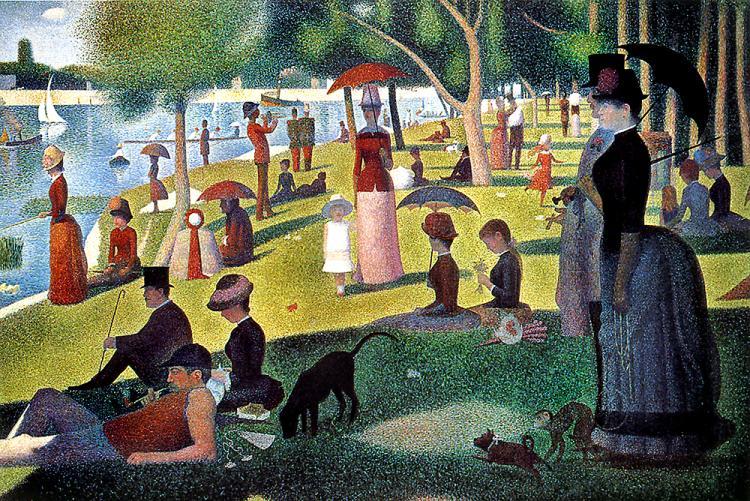
Not only that, but I also have a project in optical mixing to do.  Think pointillism.  La Grande Jatte.   Seurat.  By using individual colors in a close arrangement to each other, you can create an optical mix of the colors, and instead of seeing yellow and blue dots, you see green, when there is actually no green at all in the image.  I am NOT looking forward to this project.  I am already behind on it, but I blame the fake bomb scare guy for that.  Regardless, I have to finish this, and I have barely started.  So I have tons of work to do, plus a speech to complete and give, as well as 3 tests... all due this week.  Thursday is my last class, and then I am relatively free for the summer.  I plan on attending some community education classes (cheap and for my own knowledge and not graded) on digital photography and portraiture, but I still have to arrange things with my wife and visiting her.  However I can't think of things after Thursday, I have to finish these projects and start studying for tests.  Wish me luck!

Oh, and as far as my grades from the last big projects go...  while I am still waiting to get them back for one project (Andy Warhol color palette comparison), my speech outline got an A (94%), my Bezold Monogram (see previous posts) got an A+ (100%) and will be displayed in the hallways throughout the summer and into the fall, and my drawings and installation got a B (89%), so all that hard work paid off!  With all A's in my speech class, I am totally going to "phone in" the speech itself.  While I am passionate about the topic (vaccinations and why you should get them for your kids), I can't dedicate too much time to it.  So I will present the data I have, I will make it far more loose and ad libbed than my last speech, and much much shorter.  I want to convince them that vaccines are good, using real evidence and science and the like, but I can't dedicate that much time to it.  The drawing final is worth more of my grade than the other assignments, 20% of the total, so it has to be awesome.  The Color theory optical mixing assignment is worth the same as any large project (same as the Bezold) so I have to do well, but there is less pressure to make it an A+, and the lowest grade in the speech class will be dropped.  So if my "phoned in" speech does well, awesome, if not, who cares?

Oh, and as far as animation goes... I start classes in the fall (all animation classes), I am still interested in seeing Tin Tin despite the possibility of a visit to an uncanny valley, there is going to be a trailer to Pixar's next movie "Brave" when Cars 2 comes out in a few weeks (from what I've read it reminds me of studio Ghibli stuff), and I saw Kung Fu Panda 2.  Awesome movie.  See it.  I'll review it later.


That's all for now.  Ta ta!

Friday, April 22, 2011

A different perspective of an uncanny valley

It's that time again!
Time for another post.
For those you are not in the know... check out the other blogs attached to my right column here...  specifically Yet Another Writer's Blog, which is made by my brother.  I point this one out for 2 reasons.  First, he is my brother.. and he just had a baby!!  YAY, I'm an uncle, he's a dad, and the pressure is off me to have a kid :P.  Second, and more related to the topic of this blog, he has recently been writing about.. well..  writing.  Specifically, writing in comics.  He has talked about DC and the DC universe, about Comics in general, and has some good books listed on his site.  Check them out.  If you are interested in learning to draw your own comics, use both his and my blogs to get both aspects of comics, the writing and the drawing.
Now... to talk about this last week.  I made the "mistake" to be social last weekend with some new friends. I met with a fellow cast member (by that, I mean employee of Disney, the Disney Store in our cases), and we went to the GA Renn Faire.  I posted some pictures I took on their facebook page, so take a look!  I planned to get a lot of homework done before, and spend one night working on homework after.  Well... that plan didn't exactly work as planned.  I got tons done before, but I didn't get as far as I wanted to.  Then, another project I thought would take maybe 2 or 3 hours took about 8 to finish.  SO in the end, I went 2 nights in a row with no sleep, and one of my projects suffered from it.  My bad.
However, do not fret.  I have been getting Bs and As in all my classes so far.  The project that suffered from my lack of time and sleep was my drawing of perceptive.  We were to draw a 2 point perceptive of a hallway on the floor of our classroom, and insert 3D words in the space that described us.  I chose the word "TALL" and drew my perspective close to the ground looking up, in an attempt to make the letter look like they came straight out of the 2001 movie.  I think I did very well on this.  I spent a long long time working on the letters, the perceptive, the distances and sizes and relationships.  It looks awesome.  Except for one thing.  I spent so long working on these complex elements, I forgot to do the ceiling until the last hour.  I rushed to add some sort of ceiling there, but in the end result is flat, lacks any shading, and is in the wrong perspective.  It isn't too bad, and can be fixed (I plan to fix it cause it is too cool a drawing not to make look complete), however, I will not be graded on any fixes I make to it now.  I have to live with what he gives me.  I hope it is a B, since I spent SO long working on it and showed of some very powerful perspective skills in the most complex areas of the image.  While most people were busy eye-balling distances to make it look good and then started shading, I was literally measuring the sizes of objects in relation to each other and calculating ratios and such.  I mathematically improved the accuracy of my image, and it really worked well in it.  I just didn't have enough time.  Another hour or two would have completely saved me.
That was the bad news... the good news is that the project I was working on the first night, which I didn't expect would take nearly as long as it did, got turned in on time and completed.  I decided to write a speech about Disney, specifically, the Disney Company, specially the Innovations of Disney, in an attempt to limit my topic and talk about the highlights of the company.  I could not find all the information I wanted.  I was ready to delve into more research papers about the parks and the films, showcasing the imagineering and even the artistic techniques used in the various films to really drive home the innovation aspect.  However, thinking back on it, I am a total Disney and animation nerd, and all that would have been too much shop talk for most of my classmates.  It was good I couldn't find the really geeky stuff, it would have been too much for this speech.  I was still convinced I did an awful job writing this thing out though.  I thought my transitions needed more work, and my points were not defined clearly enough, etc.  But going a full night without sleep messes with your head... sometimes for the better I guess.  Today I got my paper back, and I got 100%!  He LOVED it.  Now the pressure is really on to make the speech kick-ass too!  I am preparing visual aids and I need to practice practice practice!  Maybe when I'm done, i can post a video of it on here (if I do well), since they will all be recorded.
I also finished the painting, and everyone loved it too.  I think that for the time I had, I did the best I could, and 2 out of 3 ain't bad.  I am convinced I did the right thing by hanging out with my friend at the Faire, since it not only helps build friendship, but it also helps me meet more people.  I met more SCAD alumni, and tons of people at the Faire, and I'm glad I went.  I wish I spent more time on my drawing, and maybe an hour less resting between classes... but I did damn good.  Granted, I will not be going to the faire again until this is all finished.
Now I am working on some drawings, and preparing the speech and visual aids.  But enough about SCAD et al, on to the topic at hand.


I said I would do a review of Tangled this week, and I am going to!  But not at this post, I will post that tomorrow or Saturday.  I'd also like to mention I finally saw Rio, and I liked it!  It wasn't perfect, and it needed some reworking of some of the characters, but I'll go into that more later in another post.  First I will sleep on it and think about the film some more. Before I get to my Tangled review later this week/weekend, I am going to go over something I have talked about a few times now with family and friends about a specific phenomenon in animated movies...  the uncanny valley.


The Uncanny Valley is a theoretical graph that essentially shows how much we like something (or have familiarity with it) based on how human it is.  This graph is really only meant to be applied to robots and animation, specifically in regards to human-like characters and machines.  It starts with very non-human things, like industrial robots.  We are not that familiar with their form, even though they often have some similarities, like an arm, and therefore we like it a little or have no emotional familiarity with it at all.  As the character becomes more human-like, it gains in our familiarity, and we like it more and more.  However, before it becomes totally human, it reaches a point where the familiarity of it plummets.  As something gets too human, but not quite human enough, it enters the dreaded uncanny valley.  This is traditionally where zombies and dead bodies lie.  They look human, but not.  It is disturbing, and throws us off, and the last place a director wants their characters to be.  If you start to look more human again, then you begin to enter a peak of familiarity again, meaning we love it even more than before.
For the most part, animation directors want their characters to stay just to the left of the valley, at the peak where they can stylize the character, and get the emotional and acting performance from the character that they need.  A good case in point here is The Incredibles (recently re-released to Blu-ray).  These characters are easily recognized as human, and yet are not lifelike at all, and have a very specific style to them.  This is the safest place to be, since it is easy to stylize the characters and over-exaggerate movements, while keeping the character likable.  Some directors want to reach the other side of the valley.  Sad to say there is no bridge over this valley, you have to fall down and climb your way back out the other side.  The only film I can think of that starts to do this (and I think is an awesome film too and will probably review at some point also) is Beowulf.  This film has managed to make the characters as lifelike as possible, dropping down the uncanny valley, and back out the other side, through not only awesome special effects that do a wonderful job of mimicking the look and motion of a human, but also through the acting.  By hiring mainly theatrical actors for motion capture, they could achieve the right level of over-the-topness that they needed for such a theatrical production.  For these reasons, and many more, I believe that this is one of the only movies ever to come back out of the uncanny valley triumphantly.  That isn't to say there aren't characters specifically in other films that do the same thing.  Dr Manhattan and Gollum are perfect examples of this as well.  In fact, Dr Manhattan goes all the way over the peak to the OTHER SIDE of the chart (not shown on this page).  He is not human enough to be human, he is more like a post human, being too perfect, almost god-like.  Is has gone past human and starts to drop down a similar peak on the other side, but luckily he does not do this, and he is still a familiar and likable character (if you get over the nudity already geez people!).
So why do I bring up the uncanny valley?  Simple!  There are several movies that have been released that have suffered from this.  Often the characters are described as being like "zombies" or "just-off".  2 cases in point would be the Polar Express (which only went down the valley a little in my opinion), and the much more recent Mars Needs Moms.  Mars Needs Moms seems to have fallen right down to the bottom of this valley.  The human characters are human enough to look human in single frames, but just off enough to look creepy and disturbing.  I have heard many people complain about these characters, and on top of a weak story, it suffered at the box office for it.  Despite the failures in these movies, i have to applaud them for one thing, being brave.  They know about the uncanny valley (or at least they should know), and they chose to dive in head first, hoping to rise up out of the other side again.  They were not really able to get out of it, but they are taking those first steps in, in an attempt to make ultra-realistic human animations.  I look forward to the day directors have the choice of making entire animated films that look either like The Incredibles in stylization, or to look absolutely human.  To have the freedom is exactly what the industry needs in a post-Avatar special effects world.  With such advanced graphics from Avatar, everyone is going to expect other movies to meet, or even raise that bar.  Well that is a high bar to reach, and there are many reasons why Avatar didn't suffer from the uncanny valley.  Most of the humans were humans, actual actors on sound stages.  The CG characters were not human, and were just not human enough to look good if they were slightly off.  Despite that, audiences are expecting miracles now in all animations, and some directors are pushing that envelope to meet those demands.
Now the studio behind Mars Needs Moms may be closing down, ImageMovers.  Sadly, they are the same studio that made Beowulf AND Polar Express.  They had big successes, and big controversy, and I was looking forward to seeing more on their remake of The Yellow Submarine.  As it stands now, Disney is no longer producing these, as ImageMovers is (or was) a Disney studio.  Whether or not ImageMovers is going to be picked up by a different producer remains to be seen, but I have my hopes that they continue to make these movies, despite the failures, in hopes of pushing the envelope further and making more great hits like Beowulf.

There is another side of this entire Uncanny Valley thing, and it involves character relationships.  I don't mean emotional relationships, I am talking about character design relationships.  Usually in a movie, specifically animated movies, you do not want some of your characters to be stylized, and others to be ultra-realistic.  Usually they don't mesh well.  Films like Roger Rabbit and Cool World do not fit into this category, because these humans are interacting with very non-human things, and the differences between the cartoons and the humans is part of the stories of each.  However, you usually want to stay away from mixing realistically drawn/rendered characters with stylized ones.  There are 2 interested exceptions in my opinion, and for opposite reasons.
First is Shrek.  In Shrek, there are characters that are both ultra-realistic, such as Fiona (who does NOT enter the uncanny valley herself since she is stylized enough, especially through her movements), and then there are the very stylized and non-human characters, such as Gingy, Pinocchio, the blind mice, and all the fairy-tale creatures.  Usually this would be weird, having these stylized character clashing with such human ones, but I feel we have a savior in our midsts.  Shrek himself is a bridge between the two worlds, not only in the story, not also in the character designs.  While he himself is not a human, he is very close to being a human (far more so than Donkey :P), while still being a fairy-tale creature.  The way I see it, Shrek has enough human qualities and realism to him, and yet enough stylization to be considered in both camps.  It is his presence, as the main character, that really brings together these 2 worlds in such a wonderful way that you hardly notice the odd miss-matched nature of the designs.  In the latest film, the witches also manage to fit into the same category.  They are very human, but just stylized enough to make them not human.
The second film is a classic, Snow White.  Here, the characters of Snow White, the Prince, and the Evil Queen are all very human and realistic.  In fact, Disney used a form of rotoscope that they developed themselves to use live action footage as reference materials for the artists.  They would use these live performances to make the animated ones all the more realistic.  To contrast this, we have the 7 dwarfs.  These little guys are so stylized, they really clash with the realistic look of the other characters.  Some people have said that this is a place where it does not work, but I disagree.  As I understand it, Walt knew that he needed the dwarfs, not for the story, but for the human element.  He realized early on that the acting of the human characters would be very limited, and it would be difficult for people to really engage with them.  If the entire movie had been made with only these human characters, it would not have been nearly as impressive as it was.  However, the stylized dwarfs were capable of far more expression, with exaggerated movements and acting.  Because of this, Walk knew people would be able to engage with these characters the most.  By using these contrasting characters, there were several different subtle effects presented.  First, you are more able to get sucked into the story of these realistic human characters on an intellectual and emotional level.  Second, you see the entire chain of events more from the dwarfs point of view, giving you a stronger emotional attachment to them, so when they get sad at their loss, you do too.  Third, the queen, prince, and princess traditionally are characters in stories and real life seen from a distance, through a looking glass.  They are idolized, iconic, and glorified.  By allowing the audience to see the story as it happens, but to feel it emotionally through the dwarfs, you get the same sense of how ideal Snow White and the others are.  You feel that they are above you, they are the iconified vision of how you think a princess and a prince and a queen should be.  As soon as the evil queen sheds her beautiful and vain body, she replaces it with one that better fits with the dwarfs, stylized and less human.  This makes her unique in that you see her as the trickster, hiding her true nature to try to appeal to your emotions, or at least Snow White's emotions.  You have now related the stylized dwarfs with the emotional aspect of the film, and seeing the witch in this form has made her all the more despicable to you.  Because of these drastic differences, and the distance between the designs of the characters, Snow White is a huge success in balancing contrasting character designs.

Now I'm sure I bored you with my geeky analysis of Snow White, Shrek, the Uncanny Valley, etc.  However, that is what I do... bore you.  No!  I mean.. geek out about animations and such.  I love to analyze and re-analyze these films, seeing them for not only their face value and their artistic worth, but also for their subtleties and complexities that are easily overlooked by your average movie goer.  The next time you hear someone talking ill about animated films as though they are "kids" movies... remember how complex these films can actually be, and how much work goes into not only the art work, but every single step of the way.

That being said, I am off to bed!  :p
I will be going to some drawing sessions later this week and next week, and I plan to have more posted soon.  Look forward to it!

Ta Ta!

Sunday, April 17, 2011

Cha Cha Cha Cha Changes

Today is time for a BIG update!!  In fact, there are LOTS of changes happening, both here in my blog and in real life, and I want to update you all on some of them.

First and foremost, I am changing the goal of this blog.  Originally this was intended to be a way of documenting my weekly endeavors in animation, which I am still going to do, but after a while, I started adding reviews, and other content.  Now I have decided that I am going to be updating about anything that I personally find interesting, with a focus toward animation and film, but not just animation.  This means if I hear something cool about... say... a scientific discovery, even if it has nothing to do with animation, I may still blog about it.  However, I will always prefer to talk about animation or the industry of animation.  So if there is a choice between talking about a great scientific advancement and the latest Disney movie, I will talk about the movie first before I talk about anything not related to animation.  I hope this isn't too confusing, but by blogging about more than just one of my interests is likely to result in more blog posts.

Second, I would like to make a few small announcements.  To start off, I have moved from Virginia to Georgia, and have started to attend SCAD.  I am in the first quarter already, and with my transfer credits, I am a sophomore, and should be able to make it to a Junior by the fall.  I also should be able to focus on only animation classes starting in the fall as well.  I have also broken the unemployment train.  I have recently been employed part-time (since school is more than full-time as is) at the Disney Store.  It is an awesome store, with great people, and is fun to work at, plus they are very helpful with giving me few hours so I can work around my school schedule.  In order to make this big change in my life, (which is huge since I went from completely available and not at all busy to barely able to keep up with the massive amount of work I suddenly have), I have had to make some serious sacrifices.  The biggest of these is that, in order to afford this, my wife is staying in Virginia, working at her current job, staying with family, while she looks for work down here and I attend classes here.  It is hard to be so separated from her on a daily basis, but we are doing our best.  I hope a job comes through soon, because we could really use it right now.

Third, I mentioned before that I do not update this blog that often.  Originally it was meant to be a weekly update, but that has obviously not happened.  SO... I am going to make this as daily as possible, keeping in mind that I am extremely busy at both school and work.  I will continue to update about any art project I am working on, both for my class and on my own.  I will NOT be blogging at all about my work, except to say that it is awesome and anyone who hasn't been to it should go.  I will continue to make movie reviews as well, time permitting of course.  I am very busy and I might not get to see a movie when it first comes out, or even after it is on disc, at least not for a while.  But some movies are just too good (or bad) not to review.

Now that that is out of the way... let me actually put in some updated content.


I would like to thank everyone in Georgia who has welcomed me.  I feel like I have found some good friends and family here already, and I hope that this will continue for the years to come.  I would also like to say "Hi" to all my fellow classmates at SCAD, who work very hard.  I promise not to write anything about anyone in particular, unless it is positive.  No negative nanny here.

Right now, I am taking a Drawing II class, a Color Theory class, and a Public Speaking class.  I have actually already taken Drawing II before, as well as Color Theory.  However, I decided that I needed some practice with drawing again, so I willingly chose to not submit a portfolio to transfer out of the drawing class.  I am enjoying it overall, even though it is difficult.  I also found that my color theory classes (yes, plural) of the past were nothing like the color theory class I am taking now.  There is a reason my credits didn't transfer.  I have never taken a Public Speaking class before, so I expect to learn a lot from this one.

Currently, I am working on a drawing focusing on 2 point perspective.  We are using both observed and imagined (added) elements to the image, and I think that, even though I have so much work to do on it, it is coming along nicely.  I will probably be spending several more hours Monday and Tuesday working on this.  I am also working on a painting focusing on different colors and small brushstrokes.  My design is a little unusual, and not as nice as I would like it to be, but I will make the best out of it.  Some of the other designs in class are awesome, and I think are going to look spectacular when they are done.  I am actually almost done with this already, and should be finished in class Monday, so I can focus my time on my other projects instead.  Finally, I am also working on a speech.  I am actually behind in this, BUT I already have a good idea what I am going to write about, and I have a good template to work off of for designing the speech.  I should be able to finish this Monday evening.  In all, I am incredibly busy with school work, but I have it all planned out and I am confident it will work out.  I wish I had some animation or comic news for you, but right now I am so busy with these "fundamentals" classes that I have no time to work on anything else right now.  That being said, I have found renewed interest in Disney, as well as my own animation projects.  I hope to make more progress on my own animation soon, time permitting of course.

In other news, I am planning to write a review for Disney's "Tangled" later this week.  Personally, I think this is a fantastic movie.  I can't give it a higher rating, and if you haven't seen it yet, go rent or buy it now!  I also have plans to review another movie called "Waking Sleeping Beauty", which is a documentary about Disney's comeback with The Little Mermaid and on, as well as "Rock and Rule", a Canadian animation from the 80's that has been all but forgotten.  I may do a review on "Rio", but right now I have not had the chance to see it yet.  I am ALSO going to talk about another movie called "The Thief and the Cobbler", which has been known by many names, was many years in the making, has undergone many changes, and suffered from many production issues.  The final release of this film is actually a fan edit release, known as the "Recobbled Edition", which used DVD footage, VHS footage, unfinished and test footage, and even storyboards in places where the animation wasn't finished or editing was needed.  While the quality is understandably lacking (being a fan edit that using unfinished footage and finished footage from many different quality sources), the edit is the best version of the movie I have seen by far!  That being said, it is very different from the original release which was released to DVD several years ago, so I will probably be doing a comparative review, talking about the differences between each edit, and where each one succeeds and fails.  To give you an idea of the differences, the main character of the original Miramax release was voiced by Matthew Broderick, while in the new edit (which is apparently closer to what the original writer had in mind) that character never speaks at all.  Good news is that Vincent Price is still the voice of Zig Zag.

Now it may take me a while to get to all of this, and I don't know what order I will do them in either just yet.  Since I am also really getting into Disney, I may talk a bit about the history of Disney and the advances they have made.  As for right now, I am going to head off.  I have to finish painting a picture, and I need to rest after a long day at the Renn Faire, while recovering from my sun burns as well.

Thursday, May 20, 2010

Comics for beginners, part 2

Last time, I said I would talk about how to find good figure drawing classes, and also how to get good resource material for drawing.  I will talk about this today, but I will also talk a little about one of the great comic book artists and writers, Phil Foglio, in my next post!  But first, the art stuff.


There are really 2 types of drawing classes: regular drawing classes (from simple to advanced), and figure drawing.  Most student love to take figure drawing, but you almost always start with drawing still-life...  that is, the boring pictures of fruit and cubes.

Still-life isn't always boring, and many artists have demonstrated a perfect knowledge of color, lighting, and shade by using still-life.  The advantages of still-life over figure drawing is that an apple doesn't need to breath or scratch, an orange doesn't need to take a break, and a wooden cube rarely charges by the hour.  So these are perfect for learning how to draw, when it comes to understanding light, shadow, form, and relationship.  As regular drawing classes progress, they often explore deeper topics.  Sometimes it gets so deep, they start to explore the relationship between drawing and painting.  What is the difference?  Why does it matter?
Once you get up to figure drawing, you start to learn the way the body is shaped, the connections and relationships, the inner-workings and the elegant lines of the form.  It is necessary for all good artists to understand the human form on a deep level if they wish to ever draw a human.  That often means drawing bones, muscles, and skulls.  But it also means drawing from live models.
My school was lucky enough to have the art department situated next door to the dancing department.  I had the pleasure of drawing many attractive young women, which is ideal for art.  Unfortunately, there were very few attractive young men who were interested, so I had only 1 class with a young man.

When you are looking for a figure drawing class, there are 2 places to look, universities/colleges, and art groups/clubs or galleries.
In order to take classes at a university or college, you first have to be enrolled in the school, often in the specific field of study, and paying your dues and fees.  Because college classes need to budget ahead of time for their term, they usually have to charge students an extra fee to help pay for the models, who do not come cheap.  This usually means there is an upfront cost, which can easily be over $100 for a term.  Not all university classes will be able to use young, attractive models either.  When young models are not available, there are plenty of older people ready to take their place.  (I swear, as an art student, you start to wonder if the only thing people do when they retire is pose naked in front of other people.)  Now drawing older people is very good too, and you can learn a lot about drawing different body types, different details such as wrinkles, and how the body ages.  I did find that most of these older models were quite good.
However, unlike colleges and universities, art groups and art galleries can chose to allow anyone to participate, provided they are willing to learn and pay to participate.  Sometimes there is a membership fee, sometimes it is an up front class-by-class fee, sometimes it is a term fee.  While I have not priced them myself, I have heard that models can easily make $100 an hour, and they will pose for several hours at a time.  That is easy money, if you think standing still in a room full of people staring at you naked is easy.  So classes of all sorts need to compensate their models for their time and service.  You may also find that some colleges and universities will offer figure drawing classes to anyone interested as well.

You will find that most figure drawing classes advertise in local art publications, local art galleries, art stores, and even online.  Art clubs and other art groups will often hold a figure drawing class in a studio, where they will either have a series of instructions for those who pay to take the class, or they will have a free form drawing session, where they provide the model, and you draw whatever you want, however you want.  That way, they do not instruct the class, they merely provide a service.  Usually, these classes range from weekly to monthly.  The average cost for these classes seems to be around $10 per class.  They will also often advertise the types of posts they will provide.  Sometimes they have long poses, that can last up to an hour, or short posts, that may last 5 minutes or less.
One exercise is to do gesture drawing.  This is where the model posts for about 30 seconds, maybe less, and changes between different poses one after the other.  The idea is that you have only enough time to get a feel for the motion, the gesture, the essence of what they are doing, how they are moving, and to get that on paper without any actual detail.  This usually allows for a good idea of motion, but it also lets you see people in motion, standing in an uncomfortable position, something you can not do in a long pose, where the model has to be as comfortable as possible.  When they have to sit or stand for 30, 45, even 60 minutes, they often needs breaks, have to be as still as they can, markers are often left where their limbs were so they can get back into position after their breaks, and maybe even need heaters to keep them warm.

Now the biggest and best advantages of drawing from real life, is that you have a person you can communicate to for your pose.  If you need them to lower their hand, or change their balance, or shift their weight, or anything else, they can do it for you.  You also have a 3D life-size model in the room, that lets you walk around them, chose your best position, and even take compliments when they do a good job.  The disadvantages are important to know as well, but are workable.  First, they are not cheap.  Also, you have a human, who moves and itches, and scratches, and has gas, and gets cold, and can sweat, and needs to breath, and take breaks.  This means they are going to be moving, even if just a little bit, which could be enough to throw you off, if you are still learning.  Sometimes the model will be perfect, other times they will be troublesome, and if you have never worked with the model before, you have no way of knowing.  Finding the right model can also be hard.  If you need a middle aged woman to pose for you, but all you can find are old men, you are out of luck.  However, the way I see it, all the great masters managed to create the most beautiful art using live models, long before still-pictures, aka photography, was invented.  If they could create these great works of art, there is no reason we can not follow their example.

Luckily, thanks to the modern science of photography, drawing from a picture is a very good experience as well.  Here, you can draw someone who is in a pose that a live person can not possibly hold, such as in the middle of the air or some other action.  You will also find photographs don't move or take breaks.  There are also a large variety of books and other resources, giving you a plethora of choices for your model and position, and usually books cost less.  However, there are some major draw backs to drawing from photography.  First, the camera.  When you are drawing from a photograph, you have to remember that a camera does not tell the truth, it tells only what it sees.  So nothing is in 3D, you cannot walk around the model and chose your position, you can not chose to readjust the focus, the lens and aperture and film and such all can affect the way the model looks.  Most images are printed at a set resolution, usually around 300 dpi, which means you are stuck with the details presented on the page, and you can not get a close look to get more information.  Whats more is that, while there are a plethora of options, sometimes it isn't enough, or it takes too long to find exactly what you want.  If the model is not right, you have to find one that is close, or keep looking.  If the model is in the wrong position, you can only change what you can figure out, but you can't reposition the model.  If the camera is at the wrong angle, there is nothing you can do to fix it.

That being said, there are a lot of good books available for figure drawing resources, that are a great help when you don't have a live model available.  This is better for if you are trying to draw something for a comic, because you can use stylization and like to compensate, but not so good for leaning if you are just starting out.  If you already can draw people, and have already had classes, these books are great.

Pose File.  From what I can tell, are are 2 series of Pose File books.  The American pose file books are good mainly for costumed super-hero and anime/manga themed comics.  All of these models are dressed, either fully, or at least in underwear.  The often are dressed in costume as well.  The book itself uses a series of camera angles for each pose, showing all of them on one page.  However, if you look at the included CD, you will find that they actually took many photos from a series of angles, with even more positions than the book has.  Since they specialize in costumes, you can see anything from superhero costumes, to schoolgirl outfits.  And of course, they pose as these comic characters should as well.  They provide various flying poses, fighting positions, weapon forms, and so on.  You can even see some detailed shots of the weapons they use.  It is good for getting some unusual shots and positions most reference books just do not do.  They have a series of them available, mostly involving action and combat poses.
Besides the American Pose File books, there are the Japanese ones.  I have not had a change to look at one of these myself, but I can say that they are available on Amazon, and usually involve nude models in various poses, including sports, dancing and martial arts.
The Nude Figure.  There are a few books by photographer Mark Smith, which explore the nude figure.  While he usually works with female nudes, you can also find men, couples, pregnant women, and unusual poses.  He has books with models jumping and dancing and moving.  His photography is excellent, with each model well depicted.  Since this is a traditional reference book, he does not provide costumes or props, and does not cater to the comic artist specifically.  However, he does an excellent job choosing which photographs to use, and provided top quality, detailed images.  His books are usually black and white, but some of them (such as this one) is in full color.  The one drawback to his work is that he does not provide panning or revolving perceptive.  He only takes the images as they are, from his perspective, and from no other position.  I find that, because of this, these are very limited in use for something like a comic artist, since we often need to have the characters in just the right position, from just the right angle.

People and Poses.  There are actually 3 books in this series.  Each one of these has a different theme, which is specific for the comic artist.  There is People and Poses, Men and Boys, and Women and Girls.  While there are other reference books by the same artist, these are the only ones that follow this theme.  He tends to photograph specifically for the comic artist, choosing which angle to present in the book.  These are in full color, and use a series of camera angles for each shot, similar to the Pose File books, but unlike the post file books, he does not represent them all on each page.  Often, these books use a single dynamic shot, one that would be ideal for a comic layout.  These each have flying shots, jumping, weapons, fighting, and more.  they use dynamic photography to give you those head on, close up, and angled shots you love to see in comics.  They even include pages from actual artists that used these models in their art, often with a presentation on how they made the shot.  The best part is, these also include a CD, which has a huge variety of poses, weapon close ups, angles, and more.  All of these use excellent side lighting to see the best details of the models, and they are all in full color.  Unfortunately, while they provide a few costumes, there are no nudes, and the models are all fully dressed or in underwear.  However, this is a minor drawback as these offer some excellent photographs, with some excellent tips and advice.

Facial Expression.  This is perhaps one of the best tools for any artist.  While you may be limited to using a mirror for your own face, these image provide you with a series of models posing in a large variety of expressions, often exaggerated for effect.  The models are listed in order from youngest to oldest, and include everything from young attractive men and women, to acne riddled teen, to the wrinkly old woman.  They include all face types, and the photographs are taken from 3 different positions surrounding the face.  They include side shots, overhead shots, 3/4 shots, straight on, and several in between.  The end of each model also has some art inspired by the expressions of that model, which are often creative and expressive.  This is an excellent way to see how other people react, how emotions are portrayed on the face, and how the age and gender and race can differentiate how we look.  As my good friend would say, it is also the favorite book of her kids, who call it the "funny face book".  The best part of this book is that it includes not only a huge series of expressions from many angles, but also a sequential expressions gallery for animators, a kissing gallery (woohoo!), a hats and headgear gallery, and a Phonemes gallery (that is the shape the mouth makes when you say words and make certain sounds)!

This is only the tip of the iceberg for reference photo books.  There are literally thousands of them out there.  There are entire websites that are dedicated to giving you the best reference picture you can find.  Some of them specialize in live models in various poses for your drawing benefit, others give you samples of various parts of the body for 3D modeling and the like.  There is even a program out there that gives you a full 360º rotation around the model, for best viewing angle.

So for the best reference material out there, you have to get to a figure drawing class or session. The more live model practice you get, the better you will become at drawing a figure from your mind, or from a small reference material like a book.  Book and photograph reference materials are also great, but only if used right.  Don't forget you can use the internet, such as google, to search for a pose, a figure type, even a costume, if you need help.  And while the photographs at websites like istockphoto, corbis and gettyimages are not free, you can often download a watermarked image with their giant logo on it, and use that for your reference for your drawing.  Just make sure you don't draw their logo with it.


Next time, Phil Foglio, and Girl Genius!