Well I have come to realize and WeaklyAnimated has fulfilled its goal as is, in that it was to chronicle my development from a weak animator to a decent one. While I still have a lot to learn and a long way to go, I have decided that Weakly Animated needs to come to an end in its current form. This means I will either shut it down, or repurpose it in the coming weeks.
I was thinking that perhaps turning it into a movie review website might work. However I am open to suggestions. But fear not, you can still keep up with all my latest art and insight and whatnot on my new blog: "Pixel of the Day". Pixel of the Day is going to be dedicated to showcasing something I made or learned every day! I want to use this as a catalyst for getting better at digital art of all kinds, and keep my content together in one place (with a less-dubious name). So for now, you can head on over to PixeloftheDay.blogspot.com to see my latest posts and artwork. Some of it may be old, some of it new, but all it will be my own work.
Thank you for all your support. Please, if you have any suggestion with what to do with Weakly Animated, send them my way!
Keep Animated!

Saturday, April 20, 2013
Monday, January 21, 2013
Vita Magus
I apologize for the long delays between posts. I really do have lots of things going on and lots of things to show people. However right now I'd like to share with everyone the official blog for one of my classes, 3D Group Project. The idea with this class is that a group of about a dozen students (grads and undergrads) make a film from start to finish in 10 weeks (or less).
The film we are making is called Vita Magus and you can find the official blog with all the updates at http://vitamagusfilm.blogspot.com
So be sure to check it out! I should be posting more soon to how projects from past quarters and add some film reviews as well.
The film we are making is called Vita Magus and you can find the official blog with all the updates at http://vitamagusfilm.blogspot.com
So be sure to check it out! I should be posting more soon to how projects from past quarters and add some film reviews as well.

Monday, November 26, 2012
End of film?
So usually I joke about the end of the world according to the Mayans. Anyone who actually looks into it will know that the Mayans did not predict anything of the sort, and yet there is one thing that may be ending sooner than expected for many, and I honestly am surprised it took this long before we started hearing about it in the news.
The end of film as we know it.
Or at least the physical medium of film. According to an article I read recently (http://m.digitaltrends.com/cool-tech/paramount-exec-announces-end-of-film-could-be-tomorrow/), the future of the physical medium of film, you know, the stuff they make movies with, and which camera used to use, is about to come to an end. I have already been personally effected by this years ago when I was working at the National Geographic Society HQ imaging department. We used to have 2 black rooms, one of which was dedicated to developing film, and the other for a special kind of printer (called a Lambda printer, which uses light sensitive paper). While I was the, the film development machine was turned off, the chemicals drained, and the room emptied and opened up. No longer sporting a dark room, film at Nat Geo had officially gone digital. And so has everyone else. Professional photographers all use DSLR (digital single lens reflex) camera, and everyday people rely on cell phones and snap-shot digital camera for their pictures. Film died in the world of Photography a long time ago. The biggest worry for Photographers was where to develop their old images and how to transition to the new digital world. All but one or two major development labs in the country shut down back then, and I would be surprised if there are any left at all now.
The problem with this wasn't that it was hard or expensive to develop, or even that film didn't produce amazing results (because it still rivals and often exceeds digital photographs), but just that the companies that made the film you put into the camera, aka Kodak and Fuji to make a few, had started to shut down their film making process. There was just no way to buy film anymore. Film was dead.
And yet now, movie companies are finally becoming painfully aware of the impending doom of film for the industry, Almost all movies made in the past decade have had some sort of digital processing done to them, and all haven been converted to a digital medium at some point, even if they were shot with film. And there is a very different visual look to film versus a digitally captured image. Film grain is a topic I could go on and on about, and how many people have strived to eliminate or reduce it but that it is actually the film grain that gives film it's unique high quality images and details. Digital images don't have a traditional film grain, but they do have a sort of dither or digitally introduced noise. The result is very different from grain.
But I digress.
It appears that the last of the film producing companies are finally facing the end of their production. Kodak has been under bankrupt protection for years and is under the control of the government now, and could pull the plug on film production at any time,. Other companies are starting to wind down their processes, and have stopped taking orders. We really are facing the end folks. The Mayans were right.
Digital "film" has now taken over, and has a promising start. While not everyone likes the look of digital over film, it is something we are all going to have to get used to. The end of an era has come, and most people aren't even going to realize it.
But this isn't a bad thing, really. The film industry has always been a leading industry, creating new technologies and adapting. When photography was first invented by Nicéphore Niépce in 1825, it didn't take long before Eadweard Muybridge started to take successive pictures of a running horse to make a form of motion picture in 1877. Ever since then, film has been making strides and leaps in technology, with better quality images, motion, sound, color, aspect ratios, animation, acting, broadcasting, and so much more. This is just the next step in the evolution of what is the Great Image Experiment. An experiment in capturing what it is to be human, what it is to be an artist.
Film may be dead, but movies and pictures will continue to evolve and define the human experience in a way no other art form can. Just remember that changes like this are a part of the innovation of such industries.
Film is dead. Long live the (digital) film!
The end of film as we know it.
Or at least the physical medium of film. According to an article I read recently (http://m.digitaltrends.com/cool-tech/paramount-exec-announces-end-of-film-could-be-tomorrow/), the future of the physical medium of film, you know, the stuff they make movies with, and which camera used to use, is about to come to an end. I have already been personally effected by this years ago when I was working at the National Geographic Society HQ imaging department. We used to have 2 black rooms, one of which was dedicated to developing film, and the other for a special kind of printer (called a Lambda printer, which uses light sensitive paper). While I was the, the film development machine was turned off, the chemicals drained, and the room emptied and opened up. No longer sporting a dark room, film at Nat Geo had officially gone digital. And so has everyone else. Professional photographers all use DSLR (digital single lens reflex) camera, and everyday people rely on cell phones and snap-shot digital camera for their pictures. Film died in the world of Photography a long time ago. The biggest worry for Photographers was where to develop their old images and how to transition to the new digital world. All but one or two major development labs in the country shut down back then, and I would be surprised if there are any left at all now.
The problem with this wasn't that it was hard or expensive to develop, or even that film didn't produce amazing results (because it still rivals and often exceeds digital photographs), but just that the companies that made the film you put into the camera, aka Kodak and Fuji to make a few, had started to shut down their film making process. There was just no way to buy film anymore. Film was dead.
And yet now, movie companies are finally becoming painfully aware of the impending doom of film for the industry, Almost all movies made in the past decade have had some sort of digital processing done to them, and all haven been converted to a digital medium at some point, even if they were shot with film. And there is a very different visual look to film versus a digitally captured image. Film grain is a topic I could go on and on about, and how many people have strived to eliminate or reduce it but that it is actually the film grain that gives film it's unique high quality images and details. Digital images don't have a traditional film grain, but they do have a sort of dither or digitally introduced noise. The result is very different from grain.
But I digress.
It appears that the last of the film producing companies are finally facing the end of their production. Kodak has been under bankrupt protection for years and is under the control of the government now, and could pull the plug on film production at any time,. Other companies are starting to wind down their processes, and have stopped taking orders. We really are facing the end folks. The Mayans were right.
Digital "film" has now taken over, and has a promising start. While not everyone likes the look of digital over film, it is something we are all going to have to get used to. The end of an era has come, and most people aren't even going to realize it.
But this isn't a bad thing, really. The film industry has always been a leading industry, creating new technologies and adapting. When photography was first invented by Nicéphore Niépce in 1825, it didn't take long before Eadweard Muybridge started to take successive pictures of a running horse to make a form of motion picture in 1877. Ever since then, film has been making strides and leaps in technology, with better quality images, motion, sound, color, aspect ratios, animation, acting, broadcasting, and so much more. This is just the next step in the evolution of what is the Great Image Experiment. An experiment in capturing what it is to be human, what it is to be an artist.
Film may be dead, but movies and pictures will continue to evolve and define the human experience in a way no other art form can. Just remember that changes like this are a part of the innovation of such industries.
Film is dead. Long live the (digital) film!
Thursday, October 18, 2012
Almost an update
Hi everyone! I know it's been MONTHS since I last updated. Well I've been really busy, but that's no excuse for failing to update my blog. So I am going to give you a hint as to what has happened and what I will be posting when I find the time to get everything together.
As of the last post, I have made several more animations, one of which was a contestant in the monthly "11 Second Club" contest (I think it was May 2012). I will post a link to that video, as well as any others I can get together. It isn't perfect, but I got the highest rank out of everyone in my class, so I am proud to have made it.
I also worked on a project that was designed to give an idea of the work flow required to make a 3D animation. There are unfinished scenes, a completely finished one, and lots of art. I have since revised the story and if I ever continue the project, I will have a much better result.
I have also been working on a portfolio website, which is still under construction but online and running. I will be updating it with more content soon.
I have also begun a whole new quarter in which I am taking 3 studio classes, a story and concept development class, a character setup and rigging class, and a MEL scripting class. I will be posting a few of the projects I've done soon, including 2 character animations from the rigging class, some art and storyboard and thumbnails from my story (which will be my senior projects), and some stills from my MEL class. It is kind of hard to show anything from MEL without just showing a recording of the interface, so I'll give screenshots with instructions as to what I was doing.
So look forward to these updates, and many more.
Ta Ta!
As of the last post, I have made several more animations, one of which was a contestant in the monthly "11 Second Club" contest (I think it was May 2012). I will post a link to that video, as well as any others I can get together. It isn't perfect, but I got the highest rank out of everyone in my class, so I am proud to have made it.
I also worked on a project that was designed to give an idea of the work flow required to make a 3D animation. There are unfinished scenes, a completely finished one, and lots of art. I have since revised the story and if I ever continue the project, I will have a much better result.
I have also been working on a portfolio website, which is still under construction but online and running. I will be updating it with more content soon.
I have also begun a whole new quarter in which I am taking 3 studio classes, a story and concept development class, a character setup and rigging class, and a MEL scripting class. I will be posting a few of the projects I've done soon, including 2 character animations from the rigging class, some art and storyboard and thumbnails from my story (which will be my senior projects), and some stills from my MEL class. It is kind of hard to show anything from MEL without just showing a recording of the interface, so I'll give screenshots with instructions as to what I was doing.
So look forward to these updates, and many more.
Ta Ta!
Tuesday, May 22, 2012
Long time coming
So I have been neglecting my blog, I know. But I've always been wanting to post. I've just been too busy. even now, I should really keep working on my projects but I figured I had too many animations done and not posted that I really should do a massive update this week. And next week... FINALS! So you will see the final products of all the things I've been working on.
Also, someone gave me the idea to put tutorials online for various techniques. I might just do that, once I figure out what to post.
Regardless, let's start with my walk cycles. Yes, 2 of them. The first is just a basic study with a tail, which is designed to help us figure out secondary motion. If anyone out there things the tail or whatnot is automatically scripted to move, think again. While big production houses might be able to set that up, often these things are going to be hand done. Especially with students.
So... first the tail walk cycle:
Also, someone gave me the idea to put tutorials online for various techniques. I might just do that, once I figure out what to post.
Regardless, let's start with my walk cycles. Yes, 2 of them. The first is just a basic study with a tail, which is designed to help us figure out secondary motion. If anyone out there things the tail or whatnot is automatically scripted to move, think again. While big production houses might be able to set that up, often these things are going to be hand done. Especially with students.
So... first the tail walk cycle:
Next up is a walk cycle that uses attitude. It can portray anything at all, be it excited or sad or whatever. I decided to do an animation for a tough cowboy. But I'm not really into cowboys... unless their robot cowboys. So... here's a robot cowboy:
Now I bring to you a full character animation. Sure the last animation was a full body robot rig, but I bound his hands to his hips. This next animation focuses on controlling a character more, and acting. Here, we have to show a change of emotion, and a shift of weight.
Speaking of weight... the next animation is all about lifting them. Honestly, this animation isn't finished, I want to add a joke at the end, however it did satisfy the requirements of the assignment, which is to show a sense of weight and balance in a character, and use acting to make something look heavy. More importantly, we learned how to make a character look like they are holding something. We do this with Ik handles and locators, which can "attach" an object to another when used properly.
[Right now there is an error on Youtube, so I will upload this in due time.]
More?! Well yes, there is lots and lots more!! I have a project I will be uploaded parts of soon that involves a robot, a girl, and a junkyard. Right now I'm calling it Junk, and it is only 3 shots. In fact, it isn't even that. it is really only 1 fully animated shot and 2 shots still "in production". This is on purpose as it is to help students figure out how long it takes to make an animation in preparation for the senior project. I will be posting some of the work on this later, so please look forward to it.
Finally, I have a dialogue animation. It is not done yet, so what you see now is merely a Work In Progress (WIP) which is only on the second animation pass. This animation is going to be an entry in the 11 Second Club. This will be done and entered into the contest by the end of the month, which is coincidentally at the end of the quarter as well. In other words, this is my final project in this class. Here is my current WIP.
One last thing, I have been working on a new portfolio website, as well as a new portfolio, resume, demo reel, business cards, etc. for my other class, professional development. You can find my new site at DHixon.com, and I will be posting some things on here as well.
Well that's all for now, I have tons more work to do! I should have work from my finals up by next week. Don't forget to follow me on the 11 Second Club (look for my entry in the forums, under the name WeaklyAnimated).
Ta ta!
Wednesday, May 2, 2012
More animations coming soon
I actually finished a few new animation this quarter to show you, an I'm really excited about the last two coming up. I'll explain more about that later. For now, I just want you to know I should have some new content up real soon. Also, this quarter has been a challenge for me, but I am finally figuring out how the rest of my BFA at SCAD is going to play out... Unless I do a minor which I am seriously considering. Then there is always doing an MFA... Decisions decisions.
Tuesday, April 10, 2012
Sleep Comes After Death
So for anyone who is familiar with SCAD, you should know that students there are often so busy with work, they don't have the time in a day to do what needs to be done for their classes. That is why God invented night. It is normal - nay - required that SCAD students work overnight at least once a quarter, if not once a week... or more. Last quarter freaked me out a little because, while I did work all night once, I never went without sleep in a 24 hour period. However, this quarter I am paying for it. Already I have had to stay up working overnight 3 times in one week... twice in a row even. Don't get me wrong, I'm not complaining. I enjoy the work (for the most part). But sleep is something every SCAD student craves and rarely gets. For me to have to lose so much sleep so soon is a little crazy, and I can only think about what the next few weeks will bring. I suppose better time management is one option, but the reality of it is that I never should have taken 3 studio courses at the same time. Unfortunately, I have to in order to graduate in a timely manner. There is a reason students joke that SCAD stands for Sleep Comes After Death.
But for me it is more like a rite of passage. If I can get through this, I can handle anything anyone can throw at me. So far I've done well, and I will continue to do my best. I am thinking of declaring a minor even, so that I have more classes to help me fill out the ones I have left. Who knows, maybe I'll go for the MFA program too (which I am seriously considering), but we'll have to see what happens a year from now first. I will, however, keep that goal in mind in case I decide I want to do it.
That being said, I wanted to let everyone know that they blog will not only be about my art and animation, as well as my development in the art world and my take on all thinks animated, but will also involve shorter posts similar to this one to help me illustrate problem solving. This is actually a recommendation from one of my professors who urged us to use our blogs for showing how we can think and evaluate and solve the problems we run into in our art.
I should also have a walk cycle up soon, but it is a boring plain one that everyone in the world has on their demo reel already. Just wait till you see the one I do with "attitude".
Stay tuned!
But for me it is more like a rite of passage. If I can get through this, I can handle anything anyone can throw at me. So far I've done well, and I will continue to do my best. I am thinking of declaring a minor even, so that I have more classes to help me fill out the ones I have left. Who knows, maybe I'll go for the MFA program too (which I am seriously considering), but we'll have to see what happens a year from now first. I will, however, keep that goal in mind in case I decide I want to do it.
That being said, I wanted to let everyone know that they blog will not only be about my art and animation, as well as my development in the art world and my take on all thinks animated, but will also involve shorter posts similar to this one to help me illustrate problem solving. This is actually a recommendation from one of my professors who urged us to use our blogs for showing how we can think and evaluate and solve the problems we run into in our art.
I should also have a walk cycle up soon, but it is a boring plain one that everyone in the world has on their demo reel already. Just wait till you see the one I do with "attitude".
Stay tuned!
Saturday, April 7, 2012
Basic 3D Animation tests
Yesterday I got to go to a talk from a Disney Interactive Director, and it was really inspiring. He knew most of my teachers, and couldn't say enough good things about SCAD and the advantages we have here. The day before I went to "AtlantAmation", a local film festival sponsored by SCAD, with many student films from SCAD. While some were better than others, I was also inspired to make my own short film. I may talk more about that later, but for now, I have several large projects looming over me.
Today, since I am knee deep in another quarter and already losing sleep over it, I will share with you 2 assignments I just completed. These are both very simple animations using Maya, and are standard animation training exercises which you will see lots of. The Bouncing Ball, and the Flour Sack. The purpose of the bouncing ball is to understand some of the most basic principles of animation, those being timing, squash, and stretch. If you look carefully, you'll see lots of bouncing ball animations online in every type of animation media out there, be it 2D or 3D. The Flour Sack animation is designed to help develop your ability to emote through a character with no face and limited motion. You are suppose to show a change in behavior or a reaction to an event or object through body language or pantomime. Again, there are lots of animations out there of flour sacks. I have a bouncing ball and a flour sack animation hand-drawn, which is posted on this site. Just look for them. Other than that, here are 2 new animations, this time in 3D!
Today, since I am knee deep in another quarter and already losing sleep over it, I will share with you 2 assignments I just completed. These are both very simple animations using Maya, and are standard animation training exercises which you will see lots of. The Bouncing Ball, and the Flour Sack. The purpose of the bouncing ball is to understand some of the most basic principles of animation, those being timing, squash, and stretch. If you look carefully, you'll see lots of bouncing ball animations online in every type of animation media out there, be it 2D or 3D. The Flour Sack animation is designed to help develop your ability to emote through a character with no face and limited motion. You are suppose to show a change in behavior or a reaction to an event or object through body language or pantomime. Again, there are lots of animations out there of flour sacks. I have a bouncing ball and a flour sack animation hand-drawn, which is posted on this site. Just look for them. Other than that, here are 2 new animations, this time in 3D!
Friday, March 16, 2012
Final Results
Well with the Winter quarter over, I have the final results of my classes. At least, that is, I have final projects. In all honesty I don't have as many this year as previous years, but I will be posting a little more in the near future from my Action Analysis class. It was all drawing, and a really great and fun class, but I have to get together from images first before I am willing to show them.
The biggest project I did was actually the scenes I did in Autodesk Maya 2012, which I posted earlier. However, I do have something else to show from that class which got me an even higher grade, and an A for the class (YAY!). That would be a character modeled in Maya using "edgelooping" to follow the flow of the muscles of the character to allow for better animation and rigging.
Originally my design was a lot more... conservative than this... and it was boring as a result (boring as in my teacher said it looked like a men's room sign and required I change it). So with some help from teachers and colleagues, I *ahem* enhanced it. This was supposed to be a modernization of Annie Oakley... and I did quite a bit of research on her. In the end, she should have an another layer of clothes at least. That and I didn't model a gun. So for now... screenshots of "Annie".
Oh... and if you are averse to nudity... 1) grow up... 2) avert your eyes. But really... no details or anything, but the clothes are removable (which means I should be able to make better clothes later) but some of these might be NSFW. Also, all of these are using the smooth preview so they are not renders, just screenshots.

The biggest project I did was actually the scenes I did in Autodesk Maya 2012, which I posted earlier. However, I do have something else to show from that class which got me an even higher grade, and an A for the class (YAY!). That would be a character modeled in Maya using "edgelooping" to follow the flow of the muscles of the character to allow for better animation and rigging.
Originally my design was a lot more... conservative than this... and it was boring as a result (boring as in my teacher said it looked like a men's room sign and required I change it). So with some help from teachers and colleagues, I *ahem* enhanced it. This was supposed to be a modernization of Annie Oakley... and I did quite a bit of research on her. In the end, she should have an another layer of clothes at least. That and I didn't model a gun. So for now... screenshots of "Annie".
Oh... and if you are averse to nudity... 1) grow up... 2) avert your eyes. But really... no details or anything, but the clothes are removable (which means I should be able to make better clothes later) but some of these might be NSFW. Also, all of these are using the smooth preview so they are not renders, just screenshots.
 |
| Overview Front Shot |
 |
| Upper Torso Shot |
 |
| Face with Edgeloops turned on |
 |
| Face without Edgloops |
 |
| Upper torso Dynamic Angle Shot |
 |
| Closeup of buckles around boots |
 |
| Closeup of medals on coat |
 |
| Closeup of gloved hand |
 |
| Closeup of ear |
 |
| Money Shot :P |
 |
| Back with Edgeloops (without coat) |
 |
| Back without Edgeloops (without coat) |
 |
| Front with Edgloops (without coat) |
 |
| Front comparison to character design sketch |
 |
| Side comparison to character design sketch |
So I made her body first, then duplicated the faces of her body to make the jacket in pieces and merged them together. I actually used a cloth dynamic in Maya to let the coat and skirt rest on her body better, but the coat is so tight it didn't move much. The gloves and boots are part of her body and don't come off. Her hair was made one "strand" at a time, with about 2 dozen modeled individually. The hat was modeled separately, as well as the buckles around her boots and the epaulettes and the medals. She was a LOT of fun to build, and I am working on fixing up her modeling a little, especially in her coat. Maybe I'll add an undershirt option as well. Her face isn't perfect either, so I will go back and tweak it some more till I have a better shape. But all said and done, I made this model in about a week, and it is my first character model ever! Pretty impressive for a first I think.
I will post more pictures later with better lighting and so forth, but I am having an issue where the coat is under "stress" (apparently a few vertices are poking through unnoticed...) which results in a funky artifact where the clothes are full of "banding"... Check it out...

So I'll be fixing that at some point and posting more images later. I'm pretty happy with it. And yes... I've noticed she has a large chest. Everyone keeps reminding me.
So next time I'll post some more on my Action Analysis class, as well as a review of Arriety. I also got a request from someone to compare GMU and SCAD, so I will be writing up a comparison, although I think it will end up being more about the differences between my experience, a typical public college, and a specialty school like SCAD.
Aloha!
Thursday, March 1, 2012
Final rendered scene
Well I have finally been forced to stay up overnight this quarter. I was getting scared there and thought it wasn't going to happen. Of course it had to be the night before a big presentation. But I'll get through it, that's what Think Geek caffeine gum is for. :)
Well today I will share with you the final rendered scenes of my project for Digital Form, Space, and Lighting. All those objects I showed earlier, well now they are all put together, with lighting, camera effects, and even environment fog. Enjoy!


Well today I will share with you the final rendered scenes of my project for Digital Form, Space, and Lighting. All those objects I showed earlier, well now they are all put together, with lighting, camera effects, and even environment fog. Enjoy!
Sunday, February 19, 2012
More 3D goodies
Hello again!
I'd like to start off apologizing to anyone who has listened to 7th Row Center and figured out I had some bad information about The Secret World of Arrietty, and Studio Ghibli, and Hayao Miyazaki himself. I realized that Patrick Stewart was in Nausicaa of the Valley of Wind, not Tales of Earthsea. I was thinking about another fine British actor, Timothy Dalton, who played Ged/Sparrowhawk in the English language version. Also, Miyazaki did not direct Arrietty; it was directed by Hiromasa Yonebayashi, who was a key animator for several other Ghibli (and non-Ghibli) films, such as Spirited Away and Ponyo. Miyazaki has been credited as a writer and executive producer, so he was involved, just not as the director.
I'm sure I got more wrong, but if you have any questions, complaints, or comments, feel free to drop us a line at 7throwcenter.com, or on facebook, or reach me directly on this site or my facebook page, or find me on twitter at @WeaklyAnimated. I know I haven't been that active on any of these lately, but I want to make sure I get good grades first, everything else comes after that.
Now that THAT is out of the way, I have some more images for people to view. I have been working on modeling and texturing these models for a few weeks, in preparation for a scene focusing around the life and world of Harry Dresden, one of my favorite characters of literature. If you are unfamiliar with Harry Dresden, I HIGHLY recommend you check out the Dresden Files novels by Jim Butcher, or the audio books narrated by James Marsters. So while I work on the lighting, take a look at the objects themselves.


I'd like to start off apologizing to anyone who has listened to 7th Row Center and figured out I had some bad information about The Secret World of Arrietty, and Studio Ghibli, and Hayao Miyazaki himself. I realized that Patrick Stewart was in Nausicaa of the Valley of Wind, not Tales of Earthsea. I was thinking about another fine British actor, Timothy Dalton, who played Ged/Sparrowhawk in the English language version. Also, Miyazaki did not direct Arrietty; it was directed by Hiromasa Yonebayashi, who was a key animator for several other Ghibli (and non-Ghibli) films, such as Spirited Away and Ponyo. Miyazaki has been credited as a writer and executive producer, so he was involved, just not as the director.
I'm sure I got more wrong, but if you have any questions, complaints, or comments, feel free to drop us a line at 7throwcenter.com, or on facebook, or reach me directly on this site or my facebook page, or find me on twitter at @WeaklyAnimated. I know I haven't been that active on any of these lately, but I want to make sure I get good grades first, everything else comes after that.
Now that THAT is out of the way, I have some more images for people to view. I have been working on modeling and texturing these models for a few weeks, in preparation for a scene focusing around the life and world of Harry Dresden, one of my favorite characters of literature. If you are unfamiliar with Harry Dresden, I HIGHLY recommend you check out the Dresden Files novels by Jim Butcher, or the audio books narrated by James Marsters. So while I work on the lighting, take a look at the objects themselves.


For those with keen eyes, yes that is Discord from My Little Ponies. Don't ask. I still have more tweaking to do, but these are pretty much finished. The rest of the scene is all about lighting and camera work. Soon, I should have fully lit scenes using 3-point lighting for you to enjoy. Comments and feedback are welcome as always.
Cheerio!
Thursday, February 9, 2012
Meet Bob
Bob is just your average guy. He's a a little short, bald, and a little nerdy, okay a lot nerdy. He lives in his friend's basement, and he absolutely LOVES the ladies. He has also amassed a library of knowledge about the supernatural and arcane. Did I mention he's a possessed skull? More accurately he's a spirit of intellect which resides in a skull in Harry Dresden's subbasement lab. Yes, Harry Dresden, the wizard. Doesn't sound familiar, look up the Dresden Files books, you will not regret it!
So why did I bring this up? Simple, I'm modeling Bob in 3D software (Maya) for one of my projects in class. We are to design a scene focused around a character or person, and I chose Harry Dresden.
So people who are real fans of the books (or audio books) will realize I did NOT get everything right (yes I know about the metal shelves, the table should be metal too, and the room is probably too small... and I am sure there are more things I missed), what I do have does give me the impression of Harry Dresden's lab.
So without further ado, I allow me to present a still of Bob, still in modeling (it is not finished, he needs teeth and texturing), but I spent a lot of time, and really pushed myself to make a skull in class.
Enjoy!

So why did I bring this up? Simple, I'm modeling Bob in 3D software (Maya) for one of my projects in class. We are to design a scene focused around a character or person, and I chose Harry Dresden.
So people who are real fans of the books (or audio books) will realize I did NOT get everything right (yes I know about the metal shelves, the table should be metal too, and the room is probably too small... and I am sure there are more things I missed), what I do have does give me the impression of Harry Dresden's lab.
So without further ado, I allow me to present a still of Bob, still in modeling (it is not finished, he needs teeth and texturing), but I spent a lot of time, and really pushed myself to make a skull in class.
Enjoy!

Bob says 'Hi'
So I will be posting more from this class soon, but first I have a busy weekend ahead of me of rendering and drawing. I will also post some drawing from my Action Analysis class later. I hope you look forward to them!
Ta ta!
Thursday, February 2, 2012
Mid term update
Sorry about having no updates so far this quarter, with my wife in town and classes in session, things just got a bit busy and I haven't been updating as a result.
Today I'd like to let you know that I will be posting some images of files I've modeled in 3D software (Maya) for one of my classes later this week. I am still perfecting it, but since midterms are here, I have no spare time and need to get these files onto the next step, texturing.
Till then, Sayonara!
Today I'd like to let you know that I will be posting some images of files I've modeled in 3D software (Maya) for one of my classes later this week. I am still perfecting it, but since midterms are here, I have no spare time and need to get these files onto the next step, texturing.
Till then, Sayonara!
Sunday, January 8, 2012
School in session
Well school is back in session, and things are looking up. Not only am I taking a 3D modeling and lighting class, but my wife and my cat have moved back in with me, thanks to a new job she got :D.
So things will be different, but better. I will still have all those late and sleepless nights doing homework, but this time I don't have to face it alone. I look forward to the classes, and have a lot of work to do already. I'll keep everyone posted.
Also, don't forget to check out the latest episode of 7th Row Center, now streaming.
So things will be different, but better. I will still have all those late and sleepless nights doing homework, but this time I don't have to face it alone. I look forward to the classes, and have a lot of work to do already. I'll keep everyone posted.
Also, don't forget to check out the latest episode of 7th Row Center, now streaming.
Monday, December 12, 2011
Animation from America to Japan
Today's post will be a bit more of an intellectual one. I have put together a term paper for one of my classes focusing on an aspect of animation I have been interested in learning more about, and will present it here as a post. I hope you find it interested, and please feel free to contact me with questions or feedback.

 I will explore the international influences that shaped anime into what it is today, and how that unique animation style has begun to affect mainstream media throughout the world. Many people believe that the essence of anime has changed due to western influences, but I argue that western influences have always been strong in Japanese animation, and it is this clash of cultures that creates what is exciting and different. I will begin by exploring how Western artists have influenced Japanese animators, focusing specifically on the works of Tezuka Osamu. I will then explore the ongoing influences that go between eastern and Western artists, and how the cultures of these artists have begun to globalize. I will finish by showing how the Japanese style of animation has invaded what we watch in theaters and on television today around the world.
 The roots of anime really begin with early animators from America and Europe, such as Blackton and McCay. In fact, by 1915, there were 21 foreign animations played nationally in Japan. Both American and German artists, such as John R. Bray, the Fleischer brothers, and Lotte ReinigerIt, were strong inspirations for early Japanese animators. A slew of animators emerged in Japan, including Shimokawa Oten, Kouchi Junichi, and Kitayama Seitaro, the earliest Japanese animators. While they pioneered the techniques and genre, there was little they produced which was particularly worthwhile. Shimokawa Oten was trained as a caricaturist and cartoonist before being hired by Tenkatsu Studio to animate specifically in the style of Émile Cohl, while Kitayama Seitaro was particularly experienced with the Western style of painting. Already, in the earliest years of anime, the Japanese style of animation was heavily influenced by the works of Western artists, not merely the techniques they pioneered. These Western style influences were not limited to the origin of anime and continued into the 1930's. Artists such as Ikuo Oishi broke away from other contemporary Japanese animators' styles, and modeled his characters after American animations such as Felix the Cat. Yokoyama Ryuichi founded the Otogi Studio in Japan after having fallen in love with animation through Walt Disney's Skeleton Dance, which aired in Japan in 1930. He created several animations and manga, and would appear in the Mainichi newspaper. He had the privilege to visit the Disney Studios in 1955, and met Walt Disney himself.
 In the 1930's and 40's, the many Japanese animations were made as propaganda films during World War II, which probably caused a strain on the animators in terms of inspiration. It seems likely that could they directly copy the styles of Western animators now that they were at war. And yet even during this troubling time, the animators would sometimes portray American soldiers as recognizable characters such as Bluto from Fleischer's Popeye as seen in Mitsuyo Seo's Momotaro, Eagle of the Sea released in 1943. Political references like this continued throughout the war and beyond. Even after the war, the government of Japan encouraged animators to make films that showed the possibilities of the West, such as the 1946 film by Masao Kumagawa, The Magic Pen. However, this had little to do with the style of the animation, and more to do with propaganda.


 Astro Boy has been translated into over a dozen different languages, and Tezuka himself was one of the first Japanese artists to attend international festivals for comics and animations. He not only pioneered airing his shows in America, but around the world, and was critically recognized for his work. The influential styles of Japanese animation were not limited to Japan, and had already been seen by artists and future animators around the world. One film which shows this obvious cross-pollination of story telling and visuals is Disney's 1994 hit movie The Lion King. Many critics have pointed out the many similarities between this film and Tezuka's Kimba the White Lion. Kimba aired on American television stations in the 60's and 70's, and many of the animators who worked on The Lion King would have grown up watching Kimba on television. Critics have claimed Disney heavily “borrowed” from Tezuka, and controversy over the idea of homage versus plagiarism sparked.


 Hayao Miyazaki fell in love with animation in 1958, when he was in high school, and went on to create one of the most influential animation studios in the world. His first major motion film, which was Castle Cagliostro, made way for his much more epic masterpieces, such as Nausicaä of the Valley of Wind, that defined his style and the studio he started, Studio Ghibli. He was not a fan of Disney-style animation, in both the use of cinematography, and rotoscoping. He wanted to create a truly Japanese style of animation which focused more on the essence of animation in expression and motion, rather than smoothness of motion. However, he was still heavily influenced by western cartoonists such as McCay, Fleischer, Back, and Norstein. Because of his unique way of looking at animation, from writing the telling the story to the art style and visuals, his animations have influenced artists world wide.

Animation from America to Japan and Back
by David Hixon, © 2011
As early as 1915, Japan has been creating their own animations for public display. However, despite these early films, animation in Japan didn't really come into its own until after WWII. Anime as it is viewed today around the world really began with artists such as Osamu Tezuka, who created a series of manga which eventually became animated in a unique style. However, if it wasn't for the animation from other countries and artists, in particular Walt Disney, he may never had inspired the anime genre as we know it.
 I will explore the international influences that shaped anime into what it is today, and how that unique animation style has begun to affect mainstream media throughout the world. Many people believe that the essence of anime has changed due to western influences, but I argue that western influences have always been strong in Japanese animation, and it is this clash of cultures that creates what is exciting and different. I will begin by exploring how Western artists have influenced Japanese animators, focusing specifically on the works of Tezuka Osamu. I will then explore the ongoing influences that go between eastern and Western artists, and how the cultures of these artists have begun to globalize. I will finish by showing how the Japanese style of animation has invaded what we watch in theaters and on television today around the world.
 The roots of anime really begin with early animators from America and Europe, such as Blackton and McCay. In fact, by 1915, there were 21 foreign animations played nationally in Japan. Both American and German artists, such as John R. Bray, the Fleischer brothers, and Lotte ReinigerIt, were strong inspirations for early Japanese animators. A slew of animators emerged in Japan, including Shimokawa Oten, Kouchi Junichi, and Kitayama Seitaro, the earliest Japanese animators. While they pioneered the techniques and genre, there was little they produced which was particularly worthwhile. Shimokawa Oten was trained as a caricaturist and cartoonist before being hired by Tenkatsu Studio to animate specifically in the style of Émile Cohl, while Kitayama Seitaro was particularly experienced with the Western style of painting. Already, in the earliest years of anime, the Japanese style of animation was heavily influenced by the works of Western artists, not merely the techniques they pioneered. These Western style influences were not limited to the origin of anime and continued into the 1930's. Artists such as Ikuo Oishi broke away from other contemporary Japanese animators' styles, and modeled his characters after American animations such as Felix the Cat. Yokoyama Ryuichi founded the Otogi Studio in Japan after having fallen in love with animation through Walt Disney's Skeleton Dance, which aired in Japan in 1930. He created several animations and manga, and would appear in the Mainichi newspaper. He had the privilege to visit the Disney Studios in 1955, and met Walt Disney himself.
 In the 1930's and 40's, the many Japanese animations were made as propaganda films during World War II, which probably caused a strain on the animators in terms of inspiration. It seems likely that could they directly copy the styles of Western animators now that they were at war. And yet even during this troubling time, the animators would sometimes portray American soldiers as recognizable characters such as Bluto from Fleischer's Popeye as seen in Mitsuyo Seo's Momotaro, Eagle of the Sea released in 1943. Political references like this continued throughout the war and beyond. Even after the war, the government of Japan encouraged animators to make films that showed the possibilities of the West, such as the 1946 film by Masao Kumagawa, The Magic Pen. However, this had little to do with the style of the animation, and more to do with propaganda.
It wasn't until a medical student decided in the 1950's to try his hand at manga and eventually anime that the modern style of anime was born. Tezuka Osamu was privileged in his youth to have access to both manga and film, including animation. Tezuka is said to have watched films like Felix the Cat in his youth, and was also influenced by Disney films, and French New Wave Cinema. This lead to his unique way of looking at animation and manga as a cinematic experience in terms of film editing, camera work, and other cinematic devices. His love of art and film from around the world gave him a unique viewpoint into the world of animation. Even the character design of Astro Boy was an homage to the early Walt Disney character styles.

On the first day of 1963, Astro Boy (Tetsuwan Atomu) was aired in Japan, and in America soon after, which was during a time when there were limited channels and airtime on television. One of the more interesting facts about this relationship between America and Japan was that Astro Boy would regularly mirror the civil rights struggles in America of the day, adding to the relations between the two countries and furthering the expansion of anime into the American market. While Astro Boy started off roughly, it soon became a world famous show, spreading the art of Japanese animation early, and invading the homes of people around the world. Tezuka produced several more series both before and after Astro Boy, which made big waves in America and abroad. Of these, Kimba the White Lion (Jungle Emperor) was among the most popular on American television.

In1967, Yoshida Tatsuo's Speed Racer (Mach Go Go Go) was aired in America as well. It gained popularity on American television, and eventually the original manga it was based on was released to western audiences as well. It became an icon of Japanese animation in its own right.
We can clearly see here that the Japanese styles used in animation were heavily influenced by their American and Western colleagues since the earliest days of Japanese produced animations. These influences continued throughout the decades, culminating in the cinematic styles that Tezuka adopted. While it is clear that the origins of anime were influenced as such, the American audience was also being slowly introduced to the phenomenon known as Anime, and despite the often controversial and bizarre shows, it became engrained in the minds of future American film makers and animators.
 Astro Boy has been translated into over a dozen different languages, and Tezuka himself was one of the first Japanese artists to attend international festivals for comics and animations. He not only pioneered airing his shows in America, but around the world, and was critically recognized for his work. The influential styles of Japanese animation were not limited to Japan, and had already been seen by artists and future animators around the world. One film which shows this obvious cross-pollination of story telling and visuals is Disney's 1994 hit movie The Lion King. Many critics have pointed out the many similarities between this film and Tezuka's Kimba the White Lion. Kimba aired on American television stations in the 60's and 70's, and many of the animators who worked on The Lion King would have grown up watching Kimba on television. Critics have claimed Disney heavily “borrowed” from Tezuka, and controversy over the idea of homage versus plagiarism sparked.
While the films and animations of Japan continue to spread throughout the world, both the styles and culture of Japan spread with it. Historically, Japan has been heavily influenced by Western cultures, and yet continues to hold onto their own unique perspective and cultural identity. It is this mix of West meets East, tradition meeds modernization, that has shaped the very soul of modern day Japan. Japan is becoming a country of a globalized culture, where they struggle to find their own identity and a place to fit within the world. Anime is one way in which Japan has turned the tables, and allowed their art to influence other cultures more than their own, and yet it also conforms to many globalized standards.
Characters in anime productions are often depicted with large eyes, multiple colors of hair and eyes, and even skin. While the characters are not always intended to be from another country, they are more often than not Western looking, copying the styles and appearance of Western cultures and people. Characters often have blond, brown, or even red hair, as well as a slew of eye colors, which directly mimic these foreign people. On the other hand, many anime characters also sport blue, green, purple, or even pink hair, as well as red or purple eyes, and even blue or green skin. This seems bizarre, but is one of the defining characteristics of anime, and brings it out of any particular culture and into something all it's own. By adopting a non-Japanese, or even “stateless” look in the characters is part of what makes anime so easily acceptable by cultures around the world.

Such mixing of ideas and styles goes both ways. Several television shows and movies in America directly reflect the Japanese style, and even the anime characteristics that define it. Avatar: The Last Airbender is one such show. The directors and producers not only copied themes, styles, and designs as well as cultural references for their series from Japanese animation, but they also researched what studios to use, and chose a Korean studio that had previously worked on Japanese anime and were familiar with the style and demands of the process. And it is not alone. Several studios are adopting an anime style for certain shows, in order to reach the demographics they are looking for. They are not just trying to mimic the look either, they are looking to emulate the style to a point where it is impossible to tell the difference between “Anime” produced in Japan versus America, at least in terms of quality and story-telling. At the very least, studios are trying to take visual and stylistic cues, and leave the real anime style to the Japanese masters.
Many American and Japanese comics are already cross-pollinating, and both manga and anime are becoming less and less a product strictly of Japan, even if the primary demographic is Japanese. The majority of Japanese anime with Western money backing it seems to be from making sequels and projects that did poorly in the Japanese market. The West's desire to acquire or produce Eastern, and particularly Japanese art dates back to the 19th Century. Anime shows a mix of traditional Japanese art that was so fascinating to the people of the time, such as Kabuki and Woodblock Prints (Ukiyo-e), and modern and even experimental cinema and artistic tools.

While many American studios have shied away attempting to emulate the Japanese style, and others have tried to make it their own, there have been several projects developed that are joint-projects between Japanese and American groups. Warner Brothers Studios commissioned a series of short animations from various anime studios and producers in Japan on more than one occasion, each time with a different movie they are to be based on. Animatrix, released to home video in 2003, is a collection of short animations, each with a different Japanese director, focusing on telling more of the story of the Wachowski Brother's Matrix. Again in 2008, they released Batman Gotham Knight under the same pretense.
These collaborations have extended into full length films as well. Several remakes and re-imaginings of different anime and manga stories have been produced in America, and several more are in production and planning. In 2009, a mainly American produced version of Astro Boy was released to theaters, with some limited interaction and approval by Tezuka Productions. This followed the 2008 release of Speed Racer, and several other anime-to-live-action remakes. This trend, to turn anime into live-action films, tends to produce mixed results, and yet there are several more films in the works for the next few years.
Beyond remaking anime series and movies for a Western audience, either through live action or animation, the most notable influence of anime in western cinema is the style it inspires in original Western works. Blockbuster films, such as 300, The Matrix, Kill Bill, and even Up, and Ratatouille, are directly inspired by the cinematic and visual styling of anime. Kill Bill went so far as to include an animated sequence produced by a Japanese animation studio in the middle of the film. However, the most interesting influences are those between anime and animation.

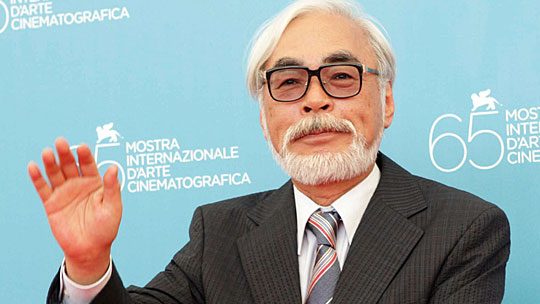 Hayao Miyazaki fell in love with animation in 1958, when he was in high school, and went on to create one of the most influential animation studios in the world. His first major motion film, which was Castle Cagliostro, made way for his much more epic masterpieces, such as Nausicaä of the Valley of Wind, that defined his style and the studio he started, Studio Ghibli. He was not a fan of Disney-style animation, in both the use of cinematography, and rotoscoping. He wanted to create a truly Japanese style of animation which focused more on the essence of animation in expression and motion, rather than smoothness of motion. However, he was still heavily influenced by western cartoonists such as McCay, Fleischer, Back, and Norstein. Because of his unique way of looking at animation, from writing the telling the story to the art style and visuals, his animations have influenced artists world wide.
Many artists, including those at Pixar Studios, grew up watching Miyazaki's films as a children, and continue to draw inspiration from him in their movies. Many have studied the drawings and animations Miyazaki made, and used what they could learn from him to his work in films like Up, and Ratatouille. Miyazaki himself became friends with John Lasseter of Pixar, visiting him at Pixar Studios on what Lasseter announced was “Miyazaki Day at Pixar”.
This type of international relationship between East and West are becoming more commonplace, and as a result, the highly stylized art and often adult and mature themes of anime have begun to spread globally and permeate cultures around the world. As a result, it can be said that Japan is losing its singular unique identity, but replacing it with a unique cultural identity of contrasting elements of society and art. Japan is both traditional and modern, conservative and edgy, and this contrast is reflected in the animation they have produced. As a result, it is easily accepted in many cultures around the world, and has influenced the artists, cartoonists, sequential artists, and filmmakers of tomorrow, and today. While the rest of the world struggles to keep up with the style of anime, the Japanese artists have drawn on inspirations from other cultures to make their art more unique and universal.
The future for anime is bright, and with international collaborations, it will prove to be even brighter. Anime was born from the unique perspective of Eastern artists studying Western art, while drawing upon their own past and experiences to support it. Thanks to efforts from artists such as Tezuka and Miyazaki, anime will continue to be an international influence on film, pushing the envelope and advancing what is possible on film, by unleashing the imagination.
Bibliography
Cavallaro, Dani. (2006). The Anime Art of Hayao Miyazaki. Jefferson, N.C.: McFarland & Co.
Drazen, Patrick. (2003). Anime Explosion! The What? Why? & Wow! Of Japanese Animation. Retrieved from
Kime, Chad. (n.d.). American Anime: Blend or Bastardization?. Accessed on October 9th, 2011. Retrieved from
Koyama-Richard, Brigitte. (2010). Japanese Animation: From Painted Scrolls to Pokémon. Paris, France: Flammarion.
Lamarre, Thomas. (2009). The Anime Machine. Minnesota, MN: University of Minnesota Press.
Lu, Amy Shirong. (2008). “The many faces of Internationalization in Japanese Anime”. Animation: An Interdisciplinary Journal. Retrieved from
Miyazaki, Hayao. (January 28th, 1988). “About Japanese Animation”. Course Japanese Movies 7: The Current Situation of Japanese Movies. Iwanami Shoten. Translated by Ryoko Toyama. Accessed on November 5th, 2011. Retrieved from
Napier, Susan J. (2005) Anime from Akira to Howl’s Moving Castle. New York, NY: Palgrave Macmillan.
Sharp, Jasper. (2004). Pioneers of Japanese Animation at PIFan. Accessed on November 5th, 2011. Retrieved from
Van der Lugt, Peter. (n.d.). Exclusive Interview with Pixar Storyboard Artist Enrico Casarosa. Accessed on October 9th, 2011. Retrieved from
Zahed, Ramin. (November 2004). “Astro Boy's American Cousins”. Animation Magazine, vol 18 (no. 11).
Filmography
Bender, Lawrence (Producer), Tarantino, Quentin (Director). (2003). Kill Bill Volume 1 [Motion Picture]. United States: Miramax.
Bird, Brad; Pinkava, Jan (Directors). (2007). Ratatouille [Motion Picture]. United States: Walt Disney / Pixar Animation Studios.
Black, Christopher (Executive Producer), Somers, Karen I. (Director). (2007). Anime: Drawing a Revolution [Television Documentary]. United States: Starz Entertainment.
Bowers, David (Director). (2009). Astro Boy [Motion Picture]. United States: Imagi Animation Studios / Imagi Crystal / Tezuka Production Company.
DiMartino, Michael Dante; Konietzko, Bryan (Producers). (2005). Avatar: The Last Airbender [Television Series]. United States: Nickelodeon Animation Studios.
Disney, Walt (Producer), Iwerks, Ub (Director). (1929). Skeleton Dance [Animated Short]. United States: Disney.
Docter, Pete; Peterson, Bob(Directors). (2009). Up [Motion Picture]. United States: Walt Disney / Pixar Animation Studios.
Fleischer, Max (Producer). (1933). Popeye The Sailor [Animated Short]. United States: Fleischer Studios/Paramount Studios.
Hanh, Don (Producer), Allers, Roger; Minkoff, Rob (Directors). (1994). The Lion King [Motion Picture]. United States: Disney.
Hidehiko, Takei; Yamamoto, Satoshi (Producers), Ishiguro, Noboru (Director). (1963). Tetsuwan Atomu (Astro Boy) [Television Series]. Japan: Mushi Productions.
Kumagawa, Masao (Director). (1946). Maho no Pen (The Magic Pen) [Animated Short]. Japan: Kyoto Eiga-sha.
Melniker, Benjamin; Thomas, Emma; Timm, Bruce W.; Uslan, Michael E. (Executive Producers). (2008) Batman: Gotham Knight [Animated Film]. United States: Warner Home Video.
Miyazaki, Hayao (Director). Katayama, Tetsuo (Producer). (1979). Rupan sansei: Kariosutoro no shiro (Lupin III: Castle Cagliostro) [Motion Picture]. Japan: Tokyo Movie Shinsha (TMS)
Miyazaki, Hayao (Director), Takahata, Isao (Producer). (1984). Nausicaä Of The Valley Of The Wind [Motion Picture]. Japan: Studio Ghibli, Disney.
Seo, Mitsuyo (Director). (1943). Momotaro no Umiwashi (Momotaro, Eagle of the Sea) [Animated Short] Japan: Geijutsu Eiga-sha / Zakka Films (USA distributor).
Tezuka, Osamu; Yamamoto, Eiichi (Producers). (1965-67). Janguru Taitei (Kimba the White Lion) [Television Series]. Japan: Mushi Productions / NBC Enterprises.
Tezuka, Osamu (Producer). (1967). Mach Go Go Go (Speed Racer) [Television Series]. Japan: Tatsunoko Productions Company.
Wachowski, Larry and Andy (Producers). (2003). Animatrix [Motion Picture]. United States: Warner Brothers.
Wachowski, Larry and Andy (Producers). (2008). Speed Racer [Motion Picture]. United States: Warner Brothers.
Supplemental Material
Anderson, Craig. (November 2009). Kimba the White Lion's Corner of the Web. Accessed on November 5th 2011. Retrieved from
Anime_Nanet. (n.d.). The Anime History - origin and roots from 1900 to the 21st century. Accessed on November 5h 2011. Retrieved from
Thursday, November 17, 2011
Post-Finals... post
Greetings again one and all!
I come to you today from the SCAD Atlanta campus at the DMC (Digital Media Center) building. I am busy working on a final project for a class. I said in the title that this is a post-finals post, and it is. This final suffered from an unfortunate event 2 days ago while I was rendering it. A teacher decided it was a good idea to log off a computer in the computer homework lab while it was rendering, without realizing that when you do that you end up deleting all the content that the previous owner added. So... All my 300+ files and hours of work was gone! I had to start from scratch and unfortunately I was unable to finish my project in time. Luckily, my professor (who is an awesome guy) got word of this, and allowed me an extension, which is a God-send. So I am here having just finished rendering it again, and will present it to him in person Friday. I hope he likes it cause I put many hours into this one (although I know there are people who put far more time into theirs, but I was busy working on another project for another class, which did get an A!). So that's where things stand at the moment at SCAD.
Unfortunately, life at home has gotten a little crazy too. Apparently today while I was out rendering, our building backed-up and flooded my apartment. SO I have the joy of going home to a wet mess and people fixing and drying things. This will probably take all weekend, and I still need to clean things up, so it might as well happen today cause everything needed to be washed anyways.
Long post short... let me present to you the project that I DID (just barely) finish on time. This animation got me an A for my Principles of 2D animation class... which brings my grade for the class up to an A! He even liked my sketchbook. So without further ado, Adam and the Flower:

And finally, in the world of professional animations.... Pixar has out a new trailer for the film "BRAVE". Check it out!:
And Studio Ghibli has released a new trailer for their film, "The Secret World of Arrietty" (based on "The Borrowers"). Check it out too!:
Unfortunately, life at home has gotten a little crazy too. Apparently today while I was out rendering, our building backed-up and flooded my apartment. SO I have the joy of going home to a wet mess and people fixing and drying things. This will probably take all weekend, and I still need to clean things up, so it might as well happen today cause everything needed to be washed anyways.
Long post short... let me present to you the project that I DID (just barely) finish on time. This animation got me an A for my Principles of 2D animation class... which brings my grade for the class up to an A! He even liked my sketchbook. So without further ado, Adam and the Flower:

Here is the final animation for my Principles of Screen Design class. The focus on this is motion, camera principles, and so on. Still awaiting a grade (since I literally just finished it):
And finally, in the world of professional animations.... Pixar has out a new trailer for the film "BRAVE". Check it out!:
Also, be sure to check out the latest episodes of 7th Row center!! This week and next week's are all about (da da da daaaa) The Muppets! So don't miss it!
So that's all for now! In the words of Porky Pig... Tha tha tha... Oh forget it.
Subscribe to:
Posts (Atom)